


Scepticism v instinct: What can humans learn from horses?
Intelligence is a strength. Until it stops us being curious.
Some years ago, we were preparing to run a Perfect Teams® workshop for a fast-growing technology company.
It was an impressive business.
Around half the team had PhDs.
Intellectual capacity to the moon and back.
Then the CEO called us.
He wanted to cancel the workshop.
His team had been pushing back so strongly against the idea that he didn’t want our facilitator subjected to their negativity and scepticism.
So the workshop never happened.
A week later, I was on my early-morning walk.
My route took me between two fields containing horses, and I was still thinking about that team.
Then a thought stopped me in my tracks.
I’d never met a sceptical horse.
INSTINCT DOESN’T ASK FOR A SPREADSHEET
Obviously, I’m not suggesting we should run businesses like horses.
But the thought stayed with me because it highlighted something interesting about human beings.
We possess an extraordinary ability to think.
To analyse.
To question.
To challenge assumptions.
To demand evidence.
To anticipate what might go wrong.
Those capabilities have transformed civilisation.
But every strength has another side.
Our ability to question can become scepticism.
Analysis can become paralysis.
Critical thinking can become closed-mindedness.
Sometimes we become so good at explaining why something won’t work that we stop being curious about whether it might.
The horse, meanwhile, gets on with being a horse.
WHAT HAPPENS WHEN A TEAM OVERTHINKS?
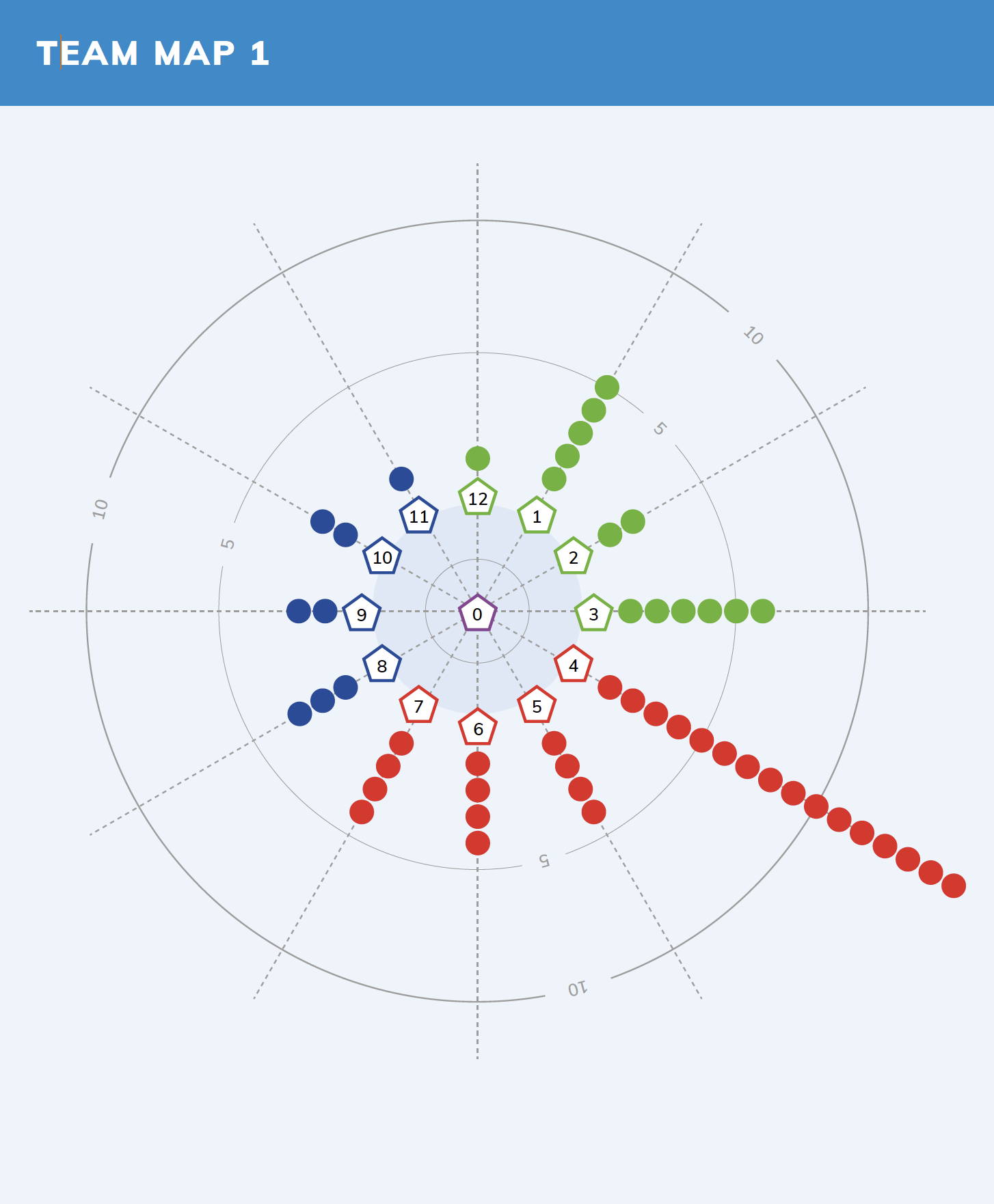
At Perfect Teams®, we identify three fundamental ways people process information and see the world.
We sometimes describe them very simply as:
Green — instinctive.
Red — relational.
Blue — intellectual.
All three bring valuable capabilities.
The problem comes when one perspective becomes so dominant that the others disappear.
The technology company was heavily weighted towards the Blue, intellectual world.
That was hardly surprising.
Its intellectual capability was one of the reasons it was successful.
But its reaction to the workshop raised another question.
Can a team’s greatest strength become its blind spot?
We’ve seen repeatedly that it can.
THE OPPOSITE PROBLEM
Years earlier, we worked with a brokerage firm whose team map showed almost the opposite pattern.
It was dominated by Green and Red characters.
There was energy.
Instinct.
Relationships.
Client acquisition.
Growth.
People moved quickly and opportunities were pursued.
But there wasn’t enough Blue.
Processes, systems, policies and procedures didn’t receive the same natural attention.
Eventually, that mattered.
The business ran into difficulties with its regulator.
Its strengths hadn’t disappeared.
They had become insufficiently balanced by another way of seeing the world.
THEN LOOK AT COMPLIANCE
We also profiled a compliance team at a European clearing house.
Its map looked almost like the inverse of the brokerage firm.
Blue dominated.
Again, that made perfect sense.
Compliance requires people who naturally pay attention to detail, rules, procedures and risk.
Put those two organisations opposite one another and you can almost see the collision coming.
One asks:
Why can’t we just get on with it?
The other asks:
Have you considered everything that could go wrong?
Neither question is wrong.
In fact, organisations need both.
SCEPTICISM IS A CAPABILITY — UNTIL IT BECOMES A BARRIER
This is the distinction I find interesting.
We need sceptics.
Every entrepreneurial leader needs somebody willing to say:
Hang on. Have we thought this through?
We need people who challenge assumptions, interrogate numbers and notice risks.
But scepticism stops being useful when the answer is decided before the question has been explored.
Equally, instinct is immensely valuable.
Sometimes there isn’t enough information.
Sometimes the opportunity won’t wait.
Sometimes experience tells you something the spreadsheet can’t.
But instinct without challenge can become recklessness.
The strength isn’t in choosing one over the other.
It’s in knowing when we need each.
What would that look like in a team?
The Perfect Teams® map below shows how differently character can be distributed across a team, and how quickly dominant strengths and missing perspectives become visible.
GREAT TEAMS DON’T JUST CONTAIN DIFFERENCE
They respect it.
That’s the crucial part.
A team can contain all sorts of different characters and still function badly if everybody thinks their own way of seeing the world is superior.
The instinctive entrepreneur dismisses the analyst as negative.
The analyst dismisses the entrepreneur as reckless.
The relationship builder thinks neither understands people.
And everybody becomes frustrated.
A capable team does something harder.
It becomes curious about difference.
What are you seeing that I’m not?
That question changes everything.
INTELLIGENCE AND CAPABILITY AREN’T THE SAME THING
This brings me back to that technology company.
Nobody could reasonably question the team’s intelligence.
Half of them had PhDs.
But intelligence alone doesn’t necessarily make a capable team.
Capability also requires curiosity.
Adaptability.
Judgement.
Communication.
Respect for different perspectives.
And sometimes the willingness to explore something before deciding whether you believe in it.
That’s an important distinction in a world where knowledge is becoming increasingly abundant.
Being able to know more isn’t the same as being able to do more.
SO, WHAT CAN HUMANS LEARN FROM HORSES?
Perhaps not very much about corporate strategy.
But that early-morning thought still makes me smile.
Because humans possess an extraordinary gift.
We can question.
The trick is not allowing that gift to prevent us from exploring.
Great teams need the instinct to move.
The intelligence to think.
The relationships that enable people to work together.
And enough respect for each to know that nobody sees the whole picture.
That’s interdependence.
So the next time somebody in your team challenges your instinct, don’t immediately dismiss them as negative.
And the next time somebody proposes something that doesn’t immediately fit your intellectual model, don’t dismiss them either.
Ask:
What can they see that I can’t?
Nobody is perfect.
But your team can be.
You can’t download capability.™
Is your team’s greatest strength also its blind spot?
Perfect Teams® makes the character of your team visible — helping you understand where strengths are concentrated, where clashes may occur and which perspectives are missing.
Originally published 20 July 2021. Updated August 2026.
 Article by: