
M&A Consulting
You Can Merge Two Businesses
Can You Merge Two Teams?
The numbers may work.
The strategy may make sense.
The structures may fit.
But mergers and acquisitions ultimately bring people together.
Different characters. Different leadership styles. Different ways of communicating, deciding and getting things done.
Perfect Teams® helps make that human architecture visible, before unseen differences become expensive problems.
See the people behind the deal.
The People Risk Is Often the Invisible Risk
Financial, commercial and legal due diligence can tell you a great deal about an organisation.
It cannot tell you how two leadership teams will work together.
Who will naturally connect?
Where will tensions arise?
Whose capability complements whose?
Where are the overlaps?
What will the combined team be missing?
And what happens when two very different organisational cultures suddenly have to become one?
These questions often become visible only after the transaction.
Perfect Teams® helps you ask them earlier.
See the Combined Team Before You Build It
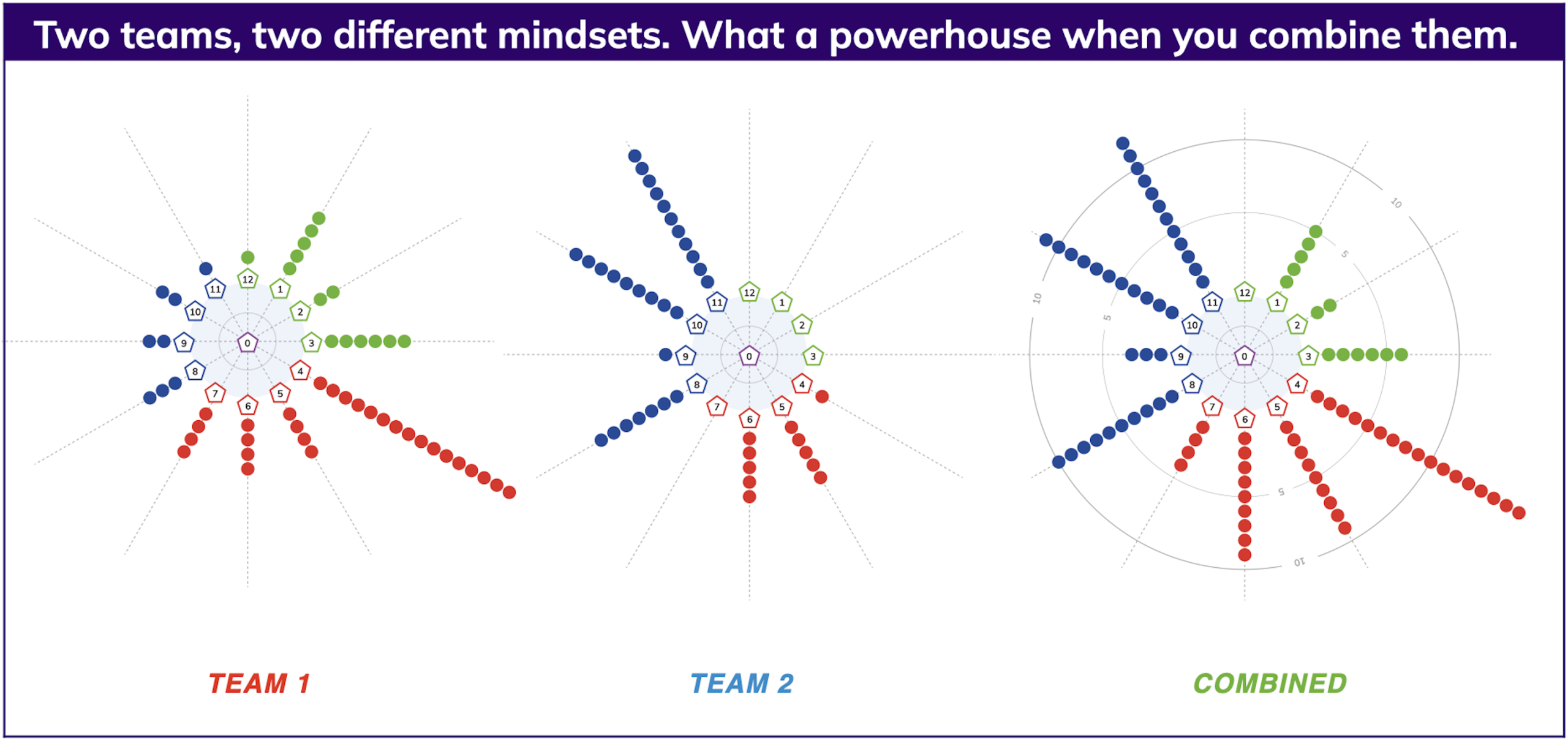
Two teams. Two very different capabilities. Unbeatable when combined.
Perfect Teams® Individual Profiles and Team Maps allow you to map the character architecture of incumbent and incoming teams.
By bringing the two maps together, you can begin to see:
- the strengths within each team;
- complementary capabilities;
- potential communication flashpoints;
- leadership differences;
- areas of duplication;
- important gaps;
- capability that may be overlooked;
- and where integration may require particular care.
What was previously intangible becomes something people can see, discuss and work with.
Character made clear. Capability made visible.
Two Organisations. One New System.
A merger doesn’t simply create a larger organisation.
It creates a new human system.
People who previously understood their place, relationships and ways of working suddenly find themselves operating alongside different people with different assumptions and expectations.
That’s why integration requires more than new structures and reporting lines.
It requires understanding.
Perfect Teams® provides a neutral framework through which both sides can begin exploring:
Who are we now?
What capability do we have?
What’s missing?
How do we work together?
From Integration to Interdependence
The objective isn’t simply to get two groups of people working alongside each other.
It’s to build a capable team from what each side brings.
That means moving beyond:
Us and them.
Towards:
We.
Beyond independence.
Towards Interdependence.
Where differences become complementary rather than divisive and individual capability becomes collective capability.
Creating the Conversation
Periods of merger and acquisition naturally create uncertainty.
Questions about roles, influence, leadership, security and the future can quickly affect trust and behaviour.
Trying to suppress those conversations rarely makes them disappear.
Perfect Teams® provides a constructive focal point for having them.
Team Maps make differences visible without making individuals the problem.
With experienced facilitation, teams can put the issues on the table and have calmer, clearer conversations about how the combined organisation needs to work.
Instead of asking:
“Who is causing the problem?”
we can ask:
“What does this new team need?”
That’s a much more useful conversation.
Where Perfect Teams® Can Help
Before the transaction
HUMAN CAPABILITY DUE DILIGENCE™
Gain deeper insight into the leadership and team capability behind the organisation you’re considering acquiring or investing in.
During integration
Team mapping and facilitation
Map the combined leadership team, identify potential strengths and flashpoints, and create a framework for constructive integration conversations.
After the transaction
Building collective capability
Help the new team develop the understanding, trust and working relationships required to move from two organisations towards one capable system.
Don’t Just Integrate the Organisation.
Integrate the Capability.
Perfect Teams® helps investors, boards and leadership teams understand the people behind the transaction — and build the collective capability required to make the new organisation work.
Start the conversation
Understand the people behind the transaction.
Successful mergers and acquisitions depend on more than commercial compatibility. Perfect® Teams helps you understand the character, capability and team dynamics that could influence integration, leadership and long-term success.
- Identify potential leadership and team compatibility risks
- Understand the character dynamics within both organisations
- Approach integration with greater clarity and confidence