

3 Steps to Improve Team Engagement
Sometimes there’s no conflict to solve.
Something in the team just isn’t visible.
Something wasn’t quite right.
There was no great conflict.
Nobody had stormed out.
No warring factions had developed.
But the CEO of a leading international sports federation could sense something.
His team wasn’t quite a team.
And there was a good reason.
THEY’D BARELY MET
The organisation was preparing for its next major international event.
Since the previous event, new people had joined.
COVID had caused enormous disruption.
The team was spread across Europe, with around half working from headquarters and the remainder remotely.
Most had never physically met.
Yet somehow these individuals had to come together and deliver an international event to an exceptionally high standard.
They didn’t have a people problem.
They had an understanding problem.
The CEO and I had worked together previously, so he called me.
He couldn’t point to a specific conflict that needed resolving.
He just knew something was missing.
That’s an interesting leadership problem.
What do you do when you can feel something in a team that you can’t yet see?
We did three things.
STEP 1: STEP BACK
The closer you are to something, the harder it can be to see it.
That’s particularly true when you’re running an organisation.
Meetings.
Emails.
Deadlines.
Customers.
Problems.
Decisions.
The hamster wheel keeps turning.
And because you’re inside the system, you experience the symptoms without necessarily seeing the pattern creating them.
I’ve increasingly come to think of this as taking the helicopter view.
Get above the activity.
Look down at the organisation.
What’s actually happening?
Where does responsibility sit?
Where are the relationships strong?
Where are they weak?
Where are people struggling?
Where is capability concentrated?
Where might something be missing?
The CEO had already taken the most important first step.
He’d recognised that delivering the next event wasn’t simply an operational challenge.
It was a team challenge.
STEP 2: SEE THE CHARACTERS
There’s an ancient injunction:
Know thyself.
It’s still a good place to start.
Each member of the team completed the Perfect Teams® indicator and received their individual character profile.
This wasn’t about putting labels on people.
It was about giving them another way to understand themselves.
What are my natural strengths?
How do I tend to communicate?
What motivates me?
What might I overlook?
How might somebody very different experience me?
And, importantly:
What happens to my strengths under pressure?
Because self-awareness isn’t capability.
But it gives capability somewhere to begin.
You can’t consciously adapt something you can’t yet see.
STEP 3: SEE THE TEAM
This is where Perfect Teams® becomes something more than an individual profiling tool.
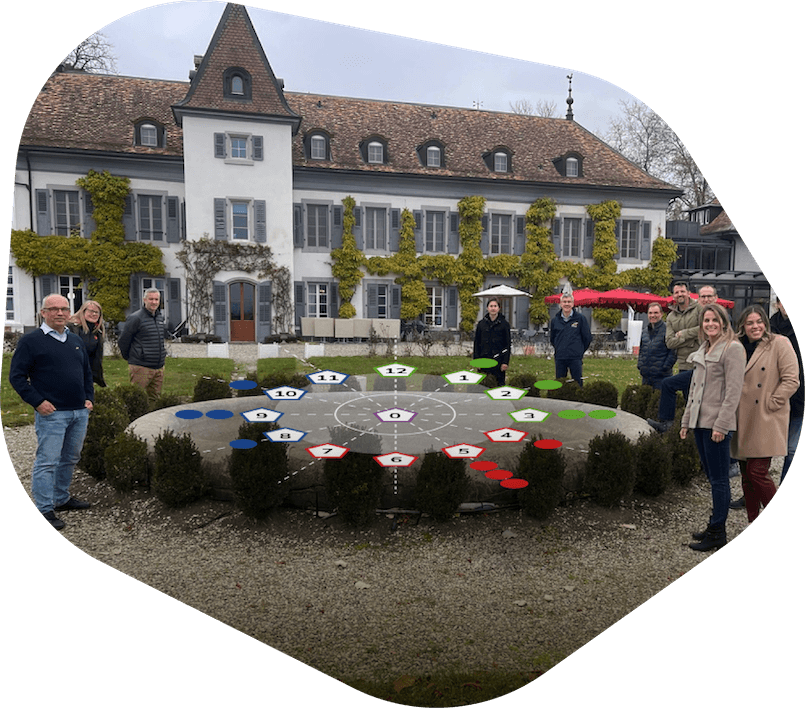
We put everybody together.
Physically.
And on the team map.
Now the individual insights became collective.
People could see where different characters sat.
Where strengths were concentrated.
Where hidden talents existed.
Where differences might create misunderstanding.
Where complementary people could work together.
And where capability might be missing.
Then we started the conversation.
Not:
“Here’s what your profile says about you.”
But:
“Here’s what I now understand about you that I didn’t understand before.”
That’s a very different conversation.
WE MADE THE INVISIBLE VISIBLE
This, for me, was the breakthrough.
Many of the things affecting a team’s effectiveness are invisible.
Character is invisible.
Motivation is invisible.
Assumptions are invisible.
Misunderstandings are invisible.
Potential is invisible.
And until something makes them visible, people fill the gaps with their own explanations.
He doesn’t care.
She’s difficult.
They’re not committed.
He never listens.
She always overcomplicates things.
Maybe.
Or perhaps you’re looking at the same situation through completely different lenses.
Once those differences become visible, something changes.
Difference stops being personal and starts becoming useful.
HYBRID WORK DIDN’T CREATE THE PROBLEM
This matters even more now.
Hybrid working is often blamed for poor engagement.
But hybrid working doesn’t necessarily create poor relationships.
It exposes weak ones.
When everybody sits in the same office, proximity can masquerade as connection.
People see one another.
Talk at the coffee machine.
Sit in meetings together.
That doesn’t mean they understand each other.
Remove the physical proximity and suddenly the quality of the relationship matters much more.
That’s why I’d hesitate to describe this as a hybrid-working problem.
It was a human-understanding problem occurring inside a hybrid team.
And those exist in offices too.
ENGAGEMENT ISN’T SOMETHING YOU DO TO PEOPLE
This is another way my thinking has evolved since I first wrote this article in 2023.
We talk about “improving employee engagement” as though engagement were something management administers.
Another initiative.
Another survey.
Another awayday.
Another benefit.
But people engage when they have reasons to engage.
When they understand what they’re contributing to.
When they feel understood.
When they understand the people around them.
When their contribution matters.
When they can use their strengths.
When they can develop.
When they belong to something.
You can’t manufacture that with an engagement programme.
You have to build the conditions in which engagement becomes possible.
AND DID IT WORK?
Following our work together, the team went on to deliver what the CEO described as the biggest international sports event of its kind for more than four decades.
He subsequently described the Perfect Teams® approach as:
“Very powerful.”
More importantly, he said it generated insights that helped the team understand the dynamics of their communication and interactions with colleagues.
That’s the bit that interests me.
Not the profile.
Not the colour.
Not the number.
What became possible because people understood something they hadn’t understood before?
That’s application.
And application builds capability.
WHAT CAN YOU SEE IN YOUR TEAM?
If something isn’t quite right in your team, don’t immediately try to fix it.
First, try to see it.
Step back.
See the characters.
See the team.
Make the invisible visible.
Then ask:
What do we understand now that we didn’t understand before?
And:
What can we do differently because we understand it?
That’s where insight becomes application.
Application becomes capability.
And individual capability begins becoming something much more valuable:
Collective capability.
Personality Divides. Character Unites.
You can’t download capability.™
Make your team visible
Perfect Teams® helps leaders see the individual characters, collective strengths, hidden talents and missing capability within their teams.
Originally published 23 February 2023. Updated August 2026.
 Article by: