

Where are you focusing your energy and attention — and what is it doing to the people around you?
Years ago, I was at a conference in York when I overheard somebody say:
“The secret is to keep living, laughing and learning.”
I liked it.
So I stole it.
Well, borrowed it and expanded it.
When people asked me how I was, instead of offering the traditional British:
“Not too bad.”
I started answering:
“Happy, healthy, horny and holy.”
Or:
“Energetic, exciting, enthusiastic and extraordinary.”
People laughed.
Some probably thought I was mad.
But something interesting happened.
Their state changed.
And so did mine.
NOT TOO BAD?
Think about that peculiarly British response for a moment.
“How are you?”
“Not too bad.”
What an extraordinary ambition for a human life.
Not good.
Not great.
Not alive.
Not excited.
Merely:
Not. Too. Bad.
Language matters because language directs attention.
And attention matters because:
Whatever you continually look for, you become remarkably good at finding.
Look for what’s wrong and you’ll find it.
Look for who’s to blame and you’ll find them.
Look for reasons something won’t work and you’ll accumulate them by lunchtime.
The world contains plenty of evidence for pessimism.
It doesn’t need your help.
A WALK WITH MY SON
Years later, I was reminded of this while walking with my son.
He’d had a temper tantrum.
Rather than lecture him, I suggested he watch the people we passed as we walked.
Just observe them.
When we reached our destination, I asked him what he’d noticed.
His answer has stayed with me.
He said unhappy people seemed to radiate a “zone of gloom” around themselves. You didn’t want to get too close.
Happy people seemed to give off a wave of attraction.
He found himself drawn towards them.
And neutral people were simply calm.
A child had spotted something adults frequently forget.
We affect the space around us.
LEADERS DON’T HAVE PRIVATE MOODS
That’s where this becomes a leadership issue.
If you’re leading people, your state doesn’t belong entirely to you.
Walk into the office irritated and people notice.
Become cynical and cynicism travels.
Blame somebody and blame becomes permissible.
Lose confidence and uncertainty spreads.
Bring energy, possibility and conviction into the room and something else can happen.
I’m not suggesting leaders should bounce around permanently grinning like demented game-show hosts.
That’s not positivity.
That’s exhausting.
Bad things happen.
People struggle.
Businesses fail.
Customers leave.
Money runs out.
People get ill.
Life can be brutal.
Positive thinking isn’t pretending everything is wonderful.
It’s deciding where you will place your attention despite the fact that it isn’t.
YOU CAN’T ALWAYS CHOOSE WHAT HAPPENS
But you can influence what happens next.
That distinction has occupied me for much of my life.
One of the phrases I’ve used for years is:
If we always think what we’ve always thought, we’ll always be what we’ve always been.
If all your attention remains fixed on the problem, eventually the problem fills the entire horizon.
Something has to interrupt the pattern.
A different thought.
A different word.
A different question.
A different action.
That’s where responsibility begins.
Not:
“Why is this happening to me?”
But:
“What can I do about it?”
Same circumstances.
Entirely different direction of travel.
I ONCE WORKED WITH A MAN WHO HAD LOST THAT CHOICE
I’ve written before about one of my earliest clients.
When I first met him, he was in a pretty dark place.
Aggressive.
Confrontational.
Unhappy at work.
He once told me that if somebody walked towards him in the street without looking where they were going, he’d deliberately walk into them.
Think about that.
He wasn’t merely encountering conflict.
He was looking for it.
And, unsurprisingly, he kept finding it.
His attention had become tuned to offence, irritation and confrontation.
It affected his work.
It affected his leadership.
And it affected his family.
Over time, things changed.
Not because the world suddenly became nicer.
He changed the way he met it.
Later, I received a card from his children.
They thanked me for:
“Giving us our dad back.”
I’ve never forgotten it.
WHERE ATTENTION GOES, ENERGY FOLLOWS
This is why I became fascinated by words in the first place.
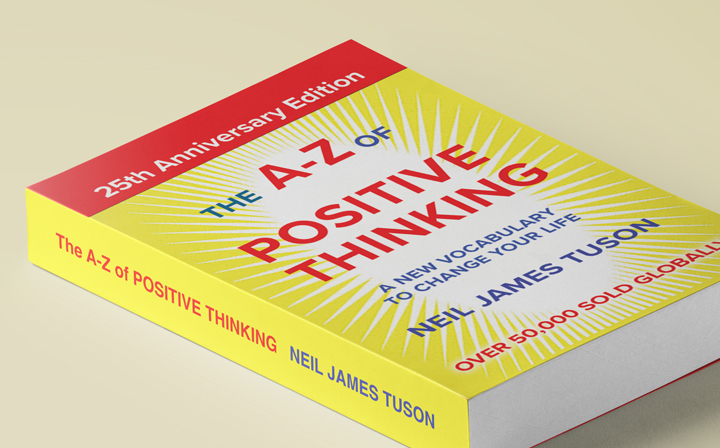
That conversation in York eventually became one of the seeds of The A–Z of Positive Thinking.
I began collecting positive words.
Playing with them.
Using them deliberately.
Watching what happened to other people.
And watching what happened to me.
The book wasn’t really about vocabulary.
It was about agency.
Can I influence my state?
Can I interrupt a negative pattern?
Can I choose a different response?
Can I move my attention from what I cannot control towards what I can?
Those questions eventually became much bigger than a little yellow book.
POSITIVITY WITHOUT RESPONSIBILITY IS JUST WISHFUL THINKING
There’s an important catch.
Positive thinking alone isn’t enough.
You can sit in the lotus position visualising a Ferrari until the finance company repossesses your bicycle.
Something has to happen.
You have to act.
That’s why positivity and responsibility belong together.
I worked with another client who initially blamed circumstances around her for what was happening in her career.
Eventually she recognised something uncomfortable but liberating.
She couldn’t control everything around her.
But she could take responsibility for her response.
Her career changed dramatically.
She ultimately became a divisional COO in a major City organisation.
And that creates another fascinating consequence.
YOUR ATTITUDE HAS A RIPPLE EFFECT
The more responsibility you carry, the further your state travels.
A miserable individual affects themselves and perhaps a few people around them.
A miserable CEO can infect an organisation.
Equally, somebody who brings possibility, confidence and responsibility into a leadership role can affect hundreds or thousands of people.
That’s power.
Not positional power.
Human power.
The ability to influence what happens next.
Which is why positivity isn’t fluffy.
It isn’t a motivational poster.
And it certainly isn’t wandering around telling everybody to cheer up.
It’s a capability.
BE POSITIVE – BE POWERFUL
The title of this article has survived since 2022.
I still believe it.
But perhaps I understand it more clearly now.
Being positive doesn’t mean believing everything will work.
It means refusing to surrender your agency to everything that doesn’t.
It means recognising that your attention is yours to direct.
Your response is yours to choose.
Your next action is yours to take.
And if you’re a leader, those choices don’t end with you.
Other people are watching.
Other people are listening.
Other people are taking their cues from the energy you bring into the room.
So ask yourself:
Where am I focusing my attention?
On what’s possible or what’s impossible?
On responsibility or blame?
On action or excuse?
On the next step or the last setback?
Because whatever you repeatedly feed with your attention gets stronger.
And eventually, so do you.
Be Positive.
Be Powerful.
You can’t download capability.™
Build the capability to lead yourself — and others
Perfect Teams® starts with understanding yourself: your character, your impact and the capabilities you need to develop to lead others more effectively.
Originally published 11 October 2022. Updated August 2026.
 Article by: