


Growth exposes everything. We make it scalable.
Growth exposes everything. We make it scalable.
When people-noise slows growth, clarity restores momentum.
The system for leaders who want to scale deliberately, not accidentally.
Why Growth Breaks Businesses and How to Fix It
FIRST:
The System
Things change
Most businesses don’t fail because the idea was wrong.
They fail because growth exposes everything that was hidden.
What worked at £500k breaks at £2m.
What worked at 10 people collapses at 30.
What worked when the founder was everywhere fails the moment they’re not.
This is not a talent problem.
It’s not a motivation problem.
And it’s rarely a strategy problem.
It’s a systems problem.
Growth changes the organisation.
More people.
More decisions.
More communication.
More handovers.
More complexity.
More opportunities for something that once happened naturally to stop happening at all.
Growth exposes everything.
SECOND:
What does ‘Scale-As-A-System™’ Mean?
Scale-As-A-System™ means designing your business so growth strengthens it, rather than destabilising it.
Instead of reacting to scale by adding more people, more meetings, and more pressure, you build the underlying architecture that allows the organisation to grow without chaos.
It recognises a simple truth:
You cannot scale output unless the system producing it can scale too.
That system includes leadership, decision-making, roles and accountability, communication, culture, energy, and critically, how people work together under pressure.
Scale isn’t simply about making the business bigger.
It’s about making the system capable of carrying more.
THIRD:
The Map
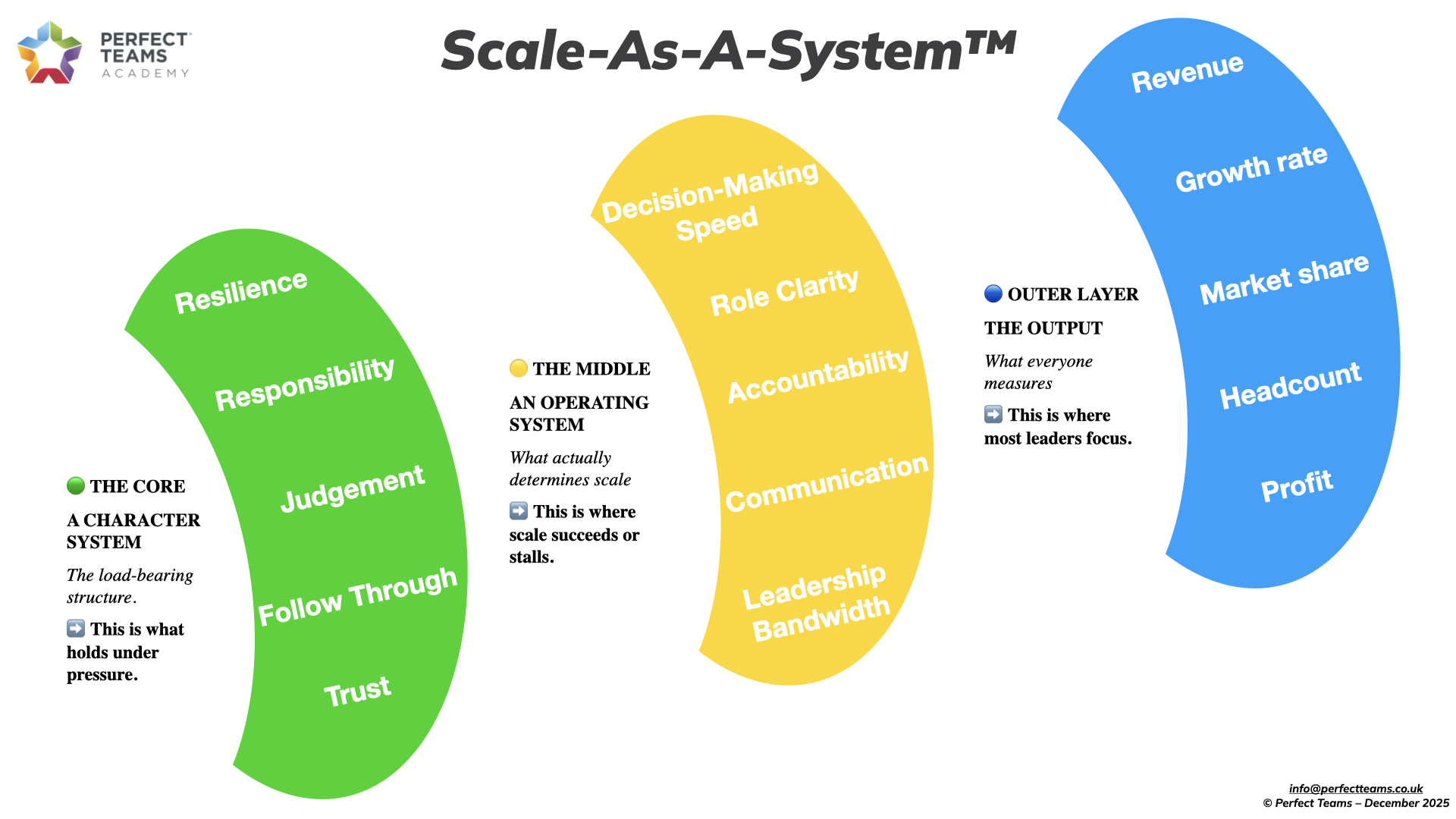
A business is not a collection of isolated functions.
It is a system.
Change one part and pressure appears somewhere else.
Increase sales without increasing delivery capability and customers suffer.
Recruit rapidly without developing leadership and managers become bottlenecks.
Add people without clarity and communication multiplies while understanding declines.
Give people responsibility without building their capability and performance becomes fragile.
The question isn’t merely:
Where do we need to grow?
It’s:
What else has to become capable because we grow?
Fourth:
Why Most Scaling Attempts Fail
When businesses grow, they often try one of three things.
They hire faster.
Headcount increases. Productivity doesn’t necessarily follow.
They push harder.
Founders work more. Firefighting intensifies.
Or they rely on strong individuals.
Capable people compensate for weak systems until eventually they can’t.
Each can create short-term movement and long-term fragility.
Scale exposes friction.
If the system isn’t designed to accommodate the growth, the friction wins.
And eventually everything comes back to the founder.
That’s not scale.
That’s dependency with a bigger payroll.
Fifth:
WHY PERSONALITY ISN’T ENOUGH AT SCALE
Personality models can be useful.
They can help people understand behaviour, preferences and differences.
But understanding personality isn’t the same as building organisational capability.
As complexity increases, leaders need to understand more than how people prefer to behave.
They need to know:
Who takes responsibility?
Who exercises judgement?
Who follows through?
Who can adapt?
Who remains effective under pressure?
What capability does the team possess?
And what is missing?
This is why Perfect Teams® starts somewhere different.
With character.
Personality describes how somebody may appear and behave.
Character helps us understand the underlying person.
And understanding character gives us another way to build capability.
Sixth:
The Role of Character in Scale
Character is part of the load-bearing structure of scale.
It influences responsibility.
Judgement.
Resilience.
Trust.
Communication.
Follow-through.
But character alone isn’t the destination.
Character is the foundation. Capability is what we build from it.
That’s an important distinction.
Perfect Teams® makes character visible so leaders can understand what people naturally bring, where differences exist, where strengths are concentrated and what may be missing.
Then comes the real work.
Developing people.
Building complementary teams.
Distributing responsibility.
Creating interdependence.
Building the human capability the growing organisation requires.
Because:
You don’t scale by adding people.
You scale by building capability.
Seventh:
Scale-As-A-System™ in Practice
Scale-As-A-System™ isn’t theory.
It’s a practical approach designed to help leaders remove people friction, protect productivity, prevent founder bottlenecks, de-risk growth and:
Add a zero without adding chaos.
It replaces reactive scaling with deliberate design.
And it asks a deceptively simple question:
Is the organisation becoming more capable as it becomes bigger?
Because if the answer is no, growth isn’t strengthening the business.
It’s increasing the load on a system that was never designed to carry it.
SUMMARY
Scale-As-A-System™ is the discipline of designing your organisation so growth increases capability rather than breaking it.
There are hundreds of ways to improve a business’s efficiency and productivity.
But scale requires something more fundamental.
The organisation itself has to change.
Its leadership.
Its people.
Its communication.
Its responsibilities.
Its decision-making.
Its teams.
Its capability.
Growth exposes everything.
The question is whether what it exposes is capable of carrying what comes next.
You can’t scale dependency.
You can’t download capability.™
Scale deliberately, not accidentally
Perfect Teams® helps leaders see the human system inside their business — what’s working, what’s missing and what needs to become more capable before the next stage of growth.
Originally published 24 December 2025. Updated August 2026.
 Article by: