

Leadership & The Capability Crisis™ — An Aside
LET’S HAVE AN HONEST CONVERSATION
Almost every discussion about the future of work asks the wrong question.
How do we protect jobs?
How do we safeguard industries?
How do we redistribute wealth?
They are all perfectly reasonable questions.
But they assume the size of the pie is fixed.
The more interesting question is:
Who is baking the next pie?
Perhaps that is the real leadership challenge of our age.
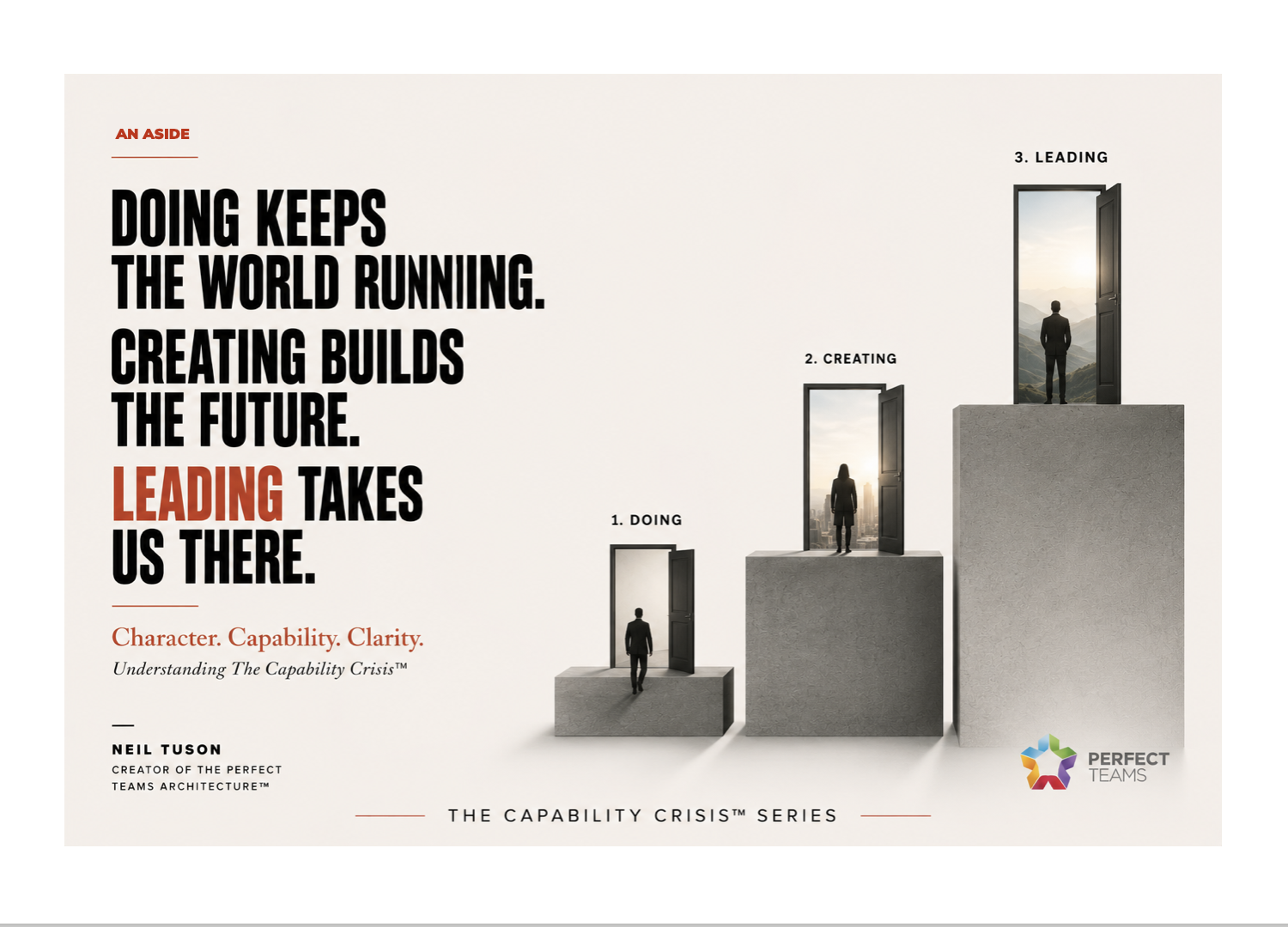
For years, I’ve found it useful to divide work into three broad levels:
Doing.
Creating.
Leading.
Not because one is better than another.
But because they perform fundamentally different roles.
1. Doing
Most people simply do.
They turn up.
Do a job.
Receive a salary.
Go home.
There is absolutely nothing wrong with that.
Every successful organisation depends upon people who consistently deliver.
But let’s not confuse employment with creation.
Recently, a client who earns several million pounds a year said to me:
“I’m still a salary slave. I simply have a very expensive salary.”
The comment stayed with me.
I’ve met chief executives, senior partners and cabinet ministers who are exceptionally good at doing the role they inherited.
But they didn’t create the opportunity itself.
They became custodians of something someone else imagined.
I was speaking recently with a distinguished City lawyer who had just retired.
She finally had the freedom to pursue what she had always wanted to do.
Archaeology.
It made me wonder how many people spend forty years earning the right to begin living.
2. Creating
This is where prosperity begins.
Not in policy papers.
Not in committees.
Not in strategy documents.
Prosperity begins the moment someone creates something another person willingly buys.
Demand creates production.
Production creates employment.
Employment creates tax revenues.
Tax revenues fund public services.
Yet I’ve attended conference after conference discussing the future of work, artificial intelligence and the economy.
Panels filled with MPs.
Ministers.
Lords.
Agency heads.
Economists.
Everyone debating how to protect existing jobs.
Almost nobody asking:
Who is creating the next generation of jobs?
We’re becoming experts at discussing the distribution of wealth.
We spend far less time discussing its creation.
It sometimes feels as though Westminster is arguing endlessly about how to divide the pie while paying remarkably little attention to who is baking the next one.
The creators.
The entrepreneurs.
The innovators.
The people prepared to risk everything on an idea.
These are the engines of growth.
If we genuinely care about employment, perhaps one of our responsibilities is to ask what helps them create — and what unnecessarily gets in their way.
3. Leading
Leadership is something else again.
And this is where I believe we become confused.
Many people we call leaders are actually stewards.
They are responsible for something that already exists.
There is dignity in that.
Good stewardship matters.
But stewardship and leadership are not quite the same thing.
True leaders create movement.
They see possibilities other people haven’t yet seen.
They create opportunities that didn’t previously exist.
They mobilise people around them.
And, at their best, they develop the capability of others to create and lead without them.
That’s important.
Because leadership isn’t simply about having people who depend upon you.
The highest expression of leadership may be creating people who no longer need to.
History remembers remarkably few true creators.
They rarely fit established forms.
They disturb comfortable assumptions.
They challenge accepted wisdom.
They often appear awkward, impatient or unreasonable until everyone else catches up.
Perhaps that’s why they are so frequently misunderstood.
Samuel Maverick gave his name to the English language because he refused to conform.
History tends to remember the people who change the direction of travel, not those who merely maintain it.
An Uncomfortable Thought
Every healthy society needs people who do.
Every prosperous society needs people who create.
Every successful civilisation needs people capable of leading.
The tragedy is that we increasingly celebrate stewardship while making creation unnecessarily difficult.
We admire security more than courage.
Process more than progress.
Management more than imagination.
Then we wonder why growth slows.
Perhaps that is another manifestation of The Capability Crisis™.
Not that we lack intelligence.
Not that we lack ambition.
But that we have become less certain how to recognise, encourage and develop the capabilities that create tomorrow’s opportunities.
Because the future will not be built by people asking only how to divide a diminishing pot.
It will be built by people with the imagination, courage and capability to create a bigger one.
Five Questions Worth Asking
- Are we spending more time arguing about how to divide the pie than asking who is baking the next one?
- Are we protecting what already exists at the expense of enabling what could exist?
- How many people making economic policy have ever had to create a payroll?
- Are our leaders creating dependency — or developing the capability of others?
- Do we want a society that rewards the capabilities that create prosperity, or one that quietly discourages them?
The Capability Crisis™
Neil Tuson is exploring why people, organisations and societies increasingly struggle, not because they lack intelligence, but because the capabilities required to create progress are rarely recognised, deliberately developed or consistently rewarded.
Character. Capability. Clarity.
Originally published 13 July 2026. Updated August 2026.
 Article by: