

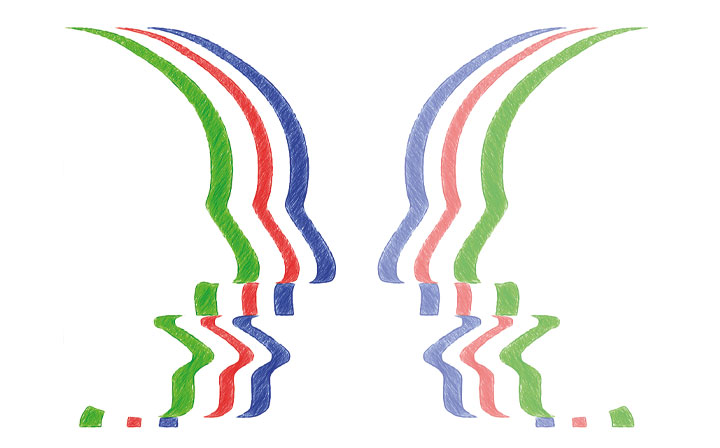
You Have Three Brains – Which of Yours Is Dominant?
How understanding character turned a compliance officer from “business preventer” into trusted adviser.
Some years ago, I was asked to work with the head of compliance inside a financial organisation.
He had a problem.
It wasn’t his technical capability.
He knew his subject extremely well.
It wasn’t his commitment.
He was meticulous, conscientious and thorough.
The problem was how the rest of the business experienced him.
To the traders, compliance wasn’t helping them do business.
It was preventing them from doing business.
There was friction between two groups of highly capable people who simply saw the world very differently.
THREE WAYS OF SEEING THE WORLD
One of the foundations of Perfect Teams® is the observation that people naturally process information in different ways.
We describe three broad orientations:
Green — Go
Blue — Think
Red — Feel
I sometimes describe them as our three brains.
Not literally three separate brains, of course.
It’s a simple metaphor for three different ways in which we naturally pay attention to and interpret the world around us.
We all have access to all three.
But most of us have a natural preference.
And therein lies both our strength and our potential blind spot.
HIS STRENGTH WAS BLUE
The compliance officer was strongly Blue.
Analytical.
Detailed.
Methodical.
Thorough.
Exactly the characteristics you might hope to find in somebody responsible for compliance.
Every month, he produced a report for the executives.
It contained everything they could possibly need to know.
And therein lay the problem.
The report was enormous.
One executive memorably described receiving it like this:
“I feel like the insides of my eyeballs are being etched with cut glass.”
The compliance officer was giving them what he would have wanted.
But they weren’t him.
THE TRADERS SAW A DIFFERENT WORLD
Many of the executives and traders were much more Green in their orientation.
They wanted the headline.
What’s happening?
What’s the risk?
What do I need to know?
What decision do I need to make?
What do we do next?
They didn’t necessarily need less rigour.
They needed the rigour translated into a form they could use.
That’s a very different problem.
And it illustrates something fundamental about communication.
Communication isn’t what you send. It’s what the other person can receive.
CHARACTER CAN CREATE FRICTION
Neither side was wrong.
Compliance needed detail.
Traders needed pace.
One existed partly to manage risk.
The other existed partly to exploit opportunity.
Put those orientations together without understanding and they can easily become adversaries.
Blue looks at Green and thinks:
Reckless.
Green looks at Blue and thinks:
Obstructive.
But those differences aren’t necessarily weaknesses.
In the right relationship, they’re complementary capabilities.
One asks:
What could go wrong?
The other asks:
What could go right?
A capable organisation needs both.
KNOWING YOURSELF IS ONLY THE BEGINNING
The first step for the compliance officer was understanding his own natural orientation.
Why did he produce reports in the way he did?
Because that’s how he processed information.
Detail gave him confidence.
Analysis gave him clarity.
Thoroughness reduced risk.
There was nothing wrong with any of that.
But self-awareness gave him another question:
What does the person receiving this need from me?
That’s where awareness begins becoming capability.
Because understanding your character isn’t about putting yourself in a box.
It’s about becoming capable of stepping outside it.
HE DIDN’T NEED TO BECOME GREEN
This distinction matters.
The answer wasn’t to turn a meticulous compliance officer into a risk-taking trader.
His Blue character was enormously valuable.
The organisation needed it.
What he needed was the capability to communicate with Green.
So the reports changed.
Instead of the equivalent of a telephone directory landing on executives’ desks every month, they received something shorter, clearer and more visual.
The analysis still existed.
The rigour hadn’t disappeared.
But the communication had been adapted to the audience.
And the relationship changed.
FROM BUSINESS PREVENTER TO TRUSTED ADVISER
The effect was dramatic.
Executives began engaging with compliance differently.
The compliance team got greater buy-in.
Friction reduced.
Relationships improved.
And the head of compliance increasingly became a trusted adviser rather than somebody perceived as an obstacle.
His technical expertise hadn’t suddenly improved.
His ability to make that expertise useful to other people had.
That’s capability.
DIFFERENCE ISN’T THE PROBLEM
This is one of the lessons that eventually became central to Perfect Teams®.
Teams don’t struggle simply because people are different.
They struggle when people don’t understand the significance of those differences.
We naturally assume other people see what we see.
Value what we value.
Need what we need.
Process information as we do.
Then we’re surprised when they don’t.
Understanding character changes the conversation.
Instead of:
Why are they so difficult?
we can ask:
What are they seeing that I’m not?
And:
What do they need from me that I’m not giving them?
That’s the beginning of interdependence.
PERSONALITY DIVIDES. CHARACTER UNITES.
Personality encourages us to look at how somebody appears.
Character helps us understand what they naturally contribute.
Green brings movement, opportunity and direction.
Blue brings analysis, structure and rigour.
Red brings relationships, connection and understanding.
None is sufficient alone.
The objective isn’t to make everybody the same.
It’s to make people sufficiently capable of understanding difference that they can use it rather than fight it.
That’s why:
Personality Divides. Character Unites.
WHICH OF YOUR THREE BRAINS IS DOMINANT?
Go?
Think?
Feel?
The interesting question isn’t simply which one you naturally prefer.
It’s what happens when you have to work with somebody who sees the world differently.
Can you adapt?
Can you communicate in a way they can receive?
Can you value what they bring rather than becoming frustrated because they aren’t like you?
Because knowing yourself is useful.
Being capable of working with people who aren’t like you is where the value begins.
Nobody is perfect.
But your team can be.
You can’t download capability.™
Where is difference creating friction in your team?
Perfect Teams® helps people understand their own character, recognise what others contribute and turn difference into stronger, more interdependent teams.
Originally published 10 January 2022. Updated August 2026.
 Article by: