
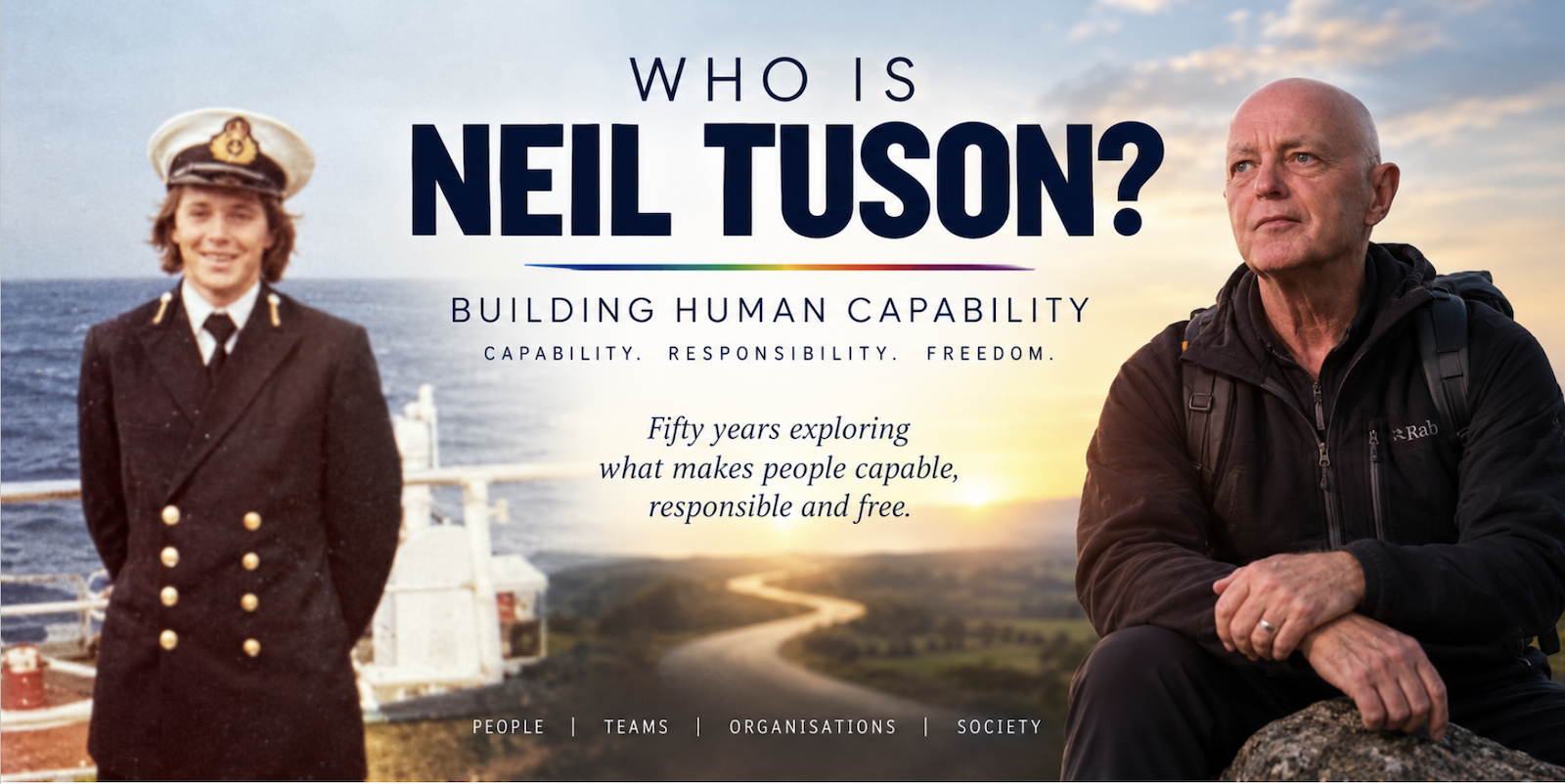
Who is Neil Tuson?
Building Human Capability
It’s a question I’ve been thinking about rather more than usual recently.
Not because I’ve suddenly developed an identity crisis.
Quite the opposite.
I’m Neil Tuson, creator of Perfect Teams®, author and, these days, an increasingly curious student of human capability.
After more than fifty years of working, learning, travelling, writing, building businesses, coaching people and creating ideas, I’ve finally realised that much of what looked like a collection of unrelated activities was actually one continuous enquiry.
What makes people capable, responsible and free?
I just didn’t have a name for it.
Today I do: Building Human Capability.
I thought I was becoming a marine engineer
My working life began at sea.
As a young marine engineer, I travelled the world keeping very large pieces of machinery running. It was a practical education in responsibility.
If something stopped working in the middle of an ocean, there wasn’t much point blaming somebody else.
You had to understand the problem, make a decision and do something about it.
Looking back, perhaps that was my first real lesson in capability.
At the time, of course, I thought I was simply learning to become a better engineer.
I wasn’t.
I was learning how to think. How to solve problems. How to take responsibility.
How to rely on myself. And, perhaps most importantly, how to keep learning.
That curiosity has never really gone away.
The journey changed. The question didn’t.
Engineering eventually gave way to business, which led to training, coaching and writing. Writing led to frameworks, models and ideas.
I built a Dale Carnegie business. I started my own businesses. I worked with thousands of people in hundreds of organisations, across different industries and different countries.
And all the time I was watching, seeking and questioning.
Why does one person flourish while another gets stuck?
Why does one person take responsibility while another waits to be told?
Why do some people cope with setbacks while others are overwhelmed by them?
Why can somebody be exceptionally well qualified and yet struggle to communicate, influence or lead?
Why do some teams become greater than the sum of their parts while others become less?
Ultimately I asked: What enables somebody to become independent and create a life on their own terms?
I kept creating things
In 1994, I wrote The A–Z of Positive Thinking.
Then came The Freedom Tree, Do-Zen—What’s Your Number? and, much later, Listening, Laughing and Learning.
Along the way I created models with names such as Three Spaces, Three Boxes, the Vision Triangle and the Act of Will.
Eventually I created Perfect Teams®, based on a simple observation that still seems obvious to me: Personality is what we present to the world. Character is what sits underneath it.
Perfect Teams grew out of my attempt to understand character, relationships and why people work brilliantly with some people and struggle with others.
At the time, I saw all these things as separate pieces of work.
I don’t anymore.
They were different attempts to understand the same thing: Human capability.
Then something changed
Technology accelerated and information became ubiquitous.
When AI arrived, something that had been sitting quietly underneath my work for decades suddenly became much more important.
For most of human history, knowing things was valuable because knowledge was difficult to acquire and tightly guarded.
Today, most of it is available in seconds.
You just need to ask a question, watch a video, download a template and now you will know.
Using AI means knowledge has become astonishingly accessible.
But there is a problem.
Knowing how to lead doesn’t make you a leader.
Knowing how to communicate doesn’t make you a communicator.
Reading about resilience doesn’t make you resilient.
Watching somebody handle a difficult conversation doesn’t give you the courage to have one yourself.
And downloading a business plan certainly doesn’t make you an entrepreneur.
Which led me to a phrase that now sits at the centre of my work:
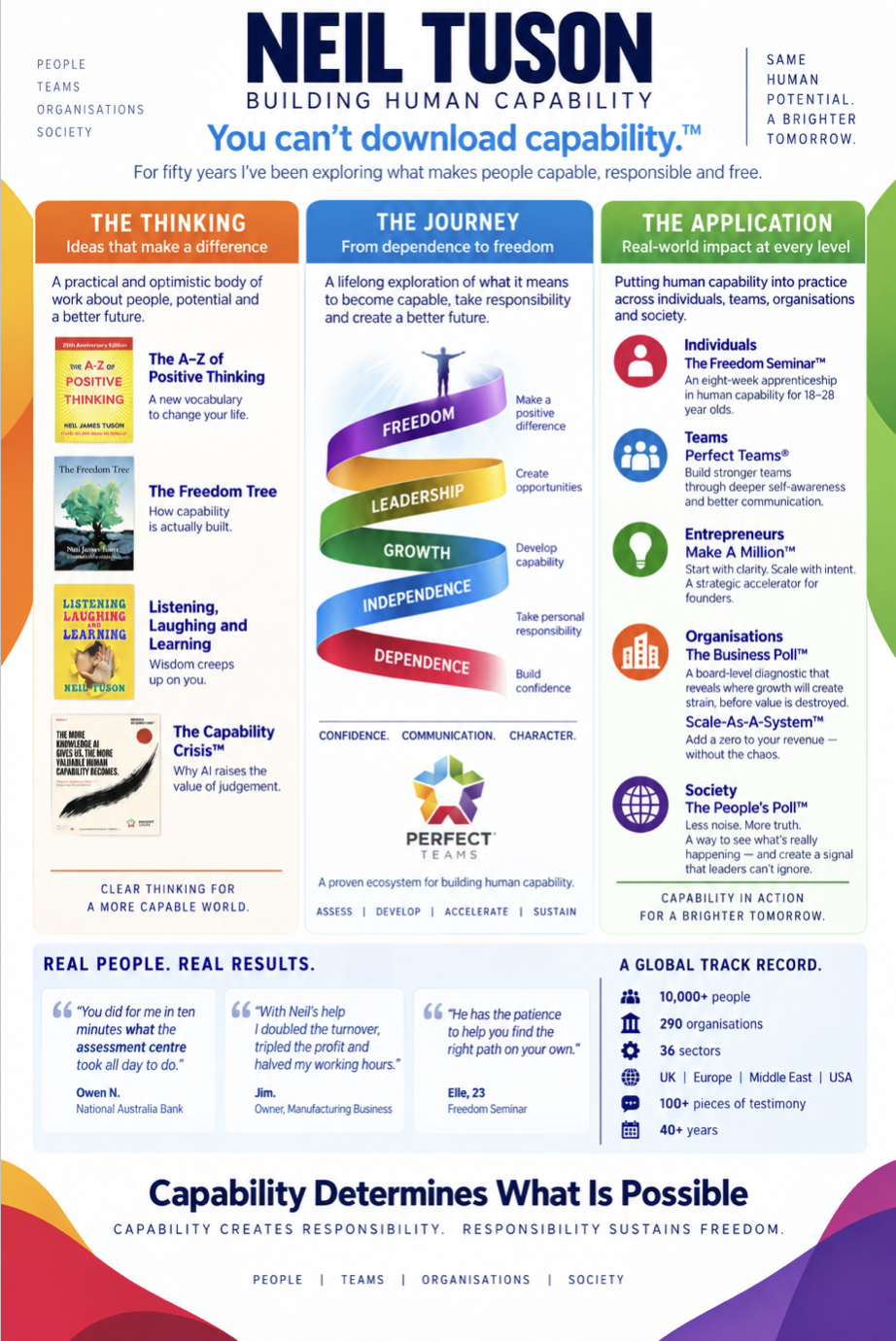
You can’t download capability.™ Capability has to be built.
The Capability Crisis™
Once I saw that distinction clearly, I began noticing it everywhere.
Employers were telling me that young people could arrive with qualifications but struggle with initiative, responsibility, communication, confidence and resilience.
Leaders could possess extraordinary technical expertise but struggle to lead people.
Businesses could have strategies, systems and technology yet still fail because the people charged with delivering them lacked the capability to do so.
AI was making knowledge more abundant while simultaneously making the distinctly human capabilities more valuable.
I started calling this The Capability Crisis™.
Not because people have suddenly become incapable.
But because the world is changing the value equation.
What you know still matters.
Increasingly, though, what distinguishes you is what you can do with what you know.
Can you take responsibility and exercise judgement?
Can you communicate and influence?
Can you recover from setbacks and carry on?
Can you build relationships and develop teams?
Can you lead and turn a vision into something tangible?
Can you turn an idea into action and exhibit initiative?
These things aren’t downloaded much like people’s attitudes aren’t downloaded.
We don’t plug in and get it we have to develop it.
Eight human capabilities
Over time, my work has crystallised around eight capabilities:
Confidence. Responsibility. Initiative. Resilience. Influence. Communication. Leadership. Relationships.
They are not the only human capabilities.
But they are the eight I have repeatedly seen make a difference to whether somebody can move forward in life and work.
And that phrase matters:
Move forward.
Because when I recently went back through decades of testimonials from people I have worked with, something struck me.
People rarely described what I had taught them.
They described what they had become able to do.
Make a decision.
Trust their judgement.
Speak up.
Get a job.
Win a promotion.
Build a business.
Lead a team.
Repair a relationship.
Turn an idea into action.
Find their own way.
I realised that, for all the models, books, workshops and businesses, much of my working life has really been about one thing: Helping people become capable of moving themselves forward.
From dependence to freedom
That brings me back to freedom.
Freedom has fascinated me for most of my life.
Not freedom from responsibility.
Almost the opposite.
The freedom that comes through responsibility.
The freedom to make choices.
To create opportunities.
To earn your own living.
To trust your judgement.
To recover when things go wrong.
To say no.
To say yes.
To choose your own direction.
To become less dependent upon other people making your decisions for you.
That is why so much of my work now fits onto a simple journey:
Dependence → Independence → Growth → Leadership → Freedom
Capability isn’t the destination.
It’s the bridge.
And that is why the work now ranges from helping an individual build confidence, through developing teams and organisations, to asking much bigger questions about education, work and society.
One practical expression of this is The Freedom Seminar™ — an eight-week apprenticeship in human capability designed to help young people become more capable of moving themselves forward.
The scale changes.
The underlying question doesn’t.
How do we build more capable human beings?
Who is Neil Tuson?
Which brings me back to the title of this article.
Years ago, I wrote a paper for the Perfect Teams Academy about developing a Personal Position.
In it I included a wonderful little template attributed to the Hollywood actor Hugh O’Brian.
He understood that celebrity was transient and described the career of an actor in five stages:
- Who is Hugh O’Brian?
2. Get me Hugh O’Brian.
3. Get me someone like Hugh O’Brian.
4. Get me a young Hugh O’Brian.
5. Who was Hugh O’Brian?
I rediscovered the paper recently.
It made me laugh.
Because I know exactly where I am.
Step 1. Who is Neil Tuson?
Like anyone else with a question nowadays I put the question into Google.
And, rather surprisingly, Google already had an answer.
It described me as a UK-based executive coach, author and entrepreneur who created Perfect Teams. It mentioned character-driven leadership and team development.
And then it mentioned The Capability Crisis™.
That stopped me.
Because something I’ve spent fifty years exploring, and only relatively recently found the language to describe, is beginning to acquire an identity of its own.
Perhaps, after all these years, all those apparently disconnected pieces are beginning to join together.
Building Human Capability
So, who is Neil Tuson?
Marine engineer.
Entrepreneur.
Coach.
Writer.
Creator of Perfect Teams.
All true.
But none quite answers the question anymore.
I think the simplest answer is this:
I’ve spent fifty years exploring what makes people capable, responsible and free.
I’ve done it partly by studying other people.
Mostly, if I’m truthful, I’ve done it by studying myself.
Trying things.
Getting things wrong.
Starting again.
Building businesses.
Losing things.
Creating things.
Walking a few ridiculous distances.
And always asking questions checking everyday if I have been:
Listening, Laughing, Loving and Learning.
And I’m still doing it.
The difference is that I now know what to call the work.
Building Human Capability.
Because capability determines what is possible.
And:
You can’t download capability.™
TO SUM UP?
My work today is about helping individuals, teams and organisations become more capable of moving themselves forward.
If that raises a question about you, your team or your organisation, let’s talk.
Originally published September 20th 2026.
 Article by: