

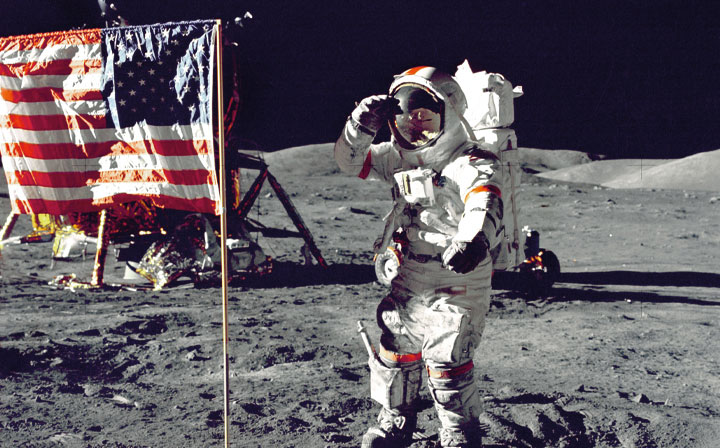
Could your team put a man on the Moon — or are their heads in the clouds?
What one of history’s greatest achievements teaches us about vision, purpose and capability.
On 25 May 1961, President John F. Kennedy stood before the United States Congress and set an extraordinary goal.
Before the decade was out, America would land a man on the Moon and return him safely to Earth.
At the time, the United States had managed just one crewed spaceflight — Alan Shepard’s 15-minute suborbital flight, only three weeks earlier.
Yet a little over eight years later, Neil Armstrong stepped onto the surface of the Moon.
It’s one of the great technological achievements in human history.
But look at Apollo through the lens of teams and something else becomes apparent.
Kennedy didn’t put a man on the Moon.
Neither did NASA.
An extraordinary system of people did.
And that raises an interesting question:
Could your team have done it?
A GREAT TEAM NEEDS MORE THAN GREAT PEOPLE
At Perfect Teams®, our work is built around 12 distinct characters and three fundamental ways people process information and see the world.
We originally described them very simply:
Green — Where and when?
Red — Why and who?
Blue — What and how?
Every organisation needs all three.
Because every worthwhile endeavour ultimately has to answer all three sets of questions.
Where are we going — and when will we get there?
Why does it matter — and who needs to care?
What needs to happen — and how are we going to do it?
The Apollo programme provides a wonderful illustration.
GREEN: WHERE AND WHEN?
Kennedy’s goal was remarkably clear.
The Moon. By the end of the decade.
People could see it.
They could understand it.
And, crucially, they would know whether they had achieved it.
That’s the power of vision.
Great visions lift people’s eyes beyond today’s problems and give direction to their effort.
But vision alone doesn’t put anyone on the Moon.
RED: WHY AND WHO?
Kennedy’s challenge came at the height of the Cold War and the space race with the Soviet Union.
America had been beaten into orbit by Yuri Gagarin. Kennedy wanted the United States not merely to catch up, but to demonstrate what it was capable of achieving. NASA’s own history describes the Cold War as the primary context for his decision.
So there was a powerful why behind the goal.
And there was an equally important who.
Kennedy understood that Apollo couldn’t belong only to a handful of astronauts.
In his 1961 speech, he made the point explicitly: it wouldn’t simply be one man going to the Moon; the endeavour would require the commitment of the nation.
Purpose turns a target into something people can belong to.
As we’ve said for years at Perfect Teams®:
No why = no way.
But vision and purpose still aren’t enough.
Someone has to work out how to get there.
BLUE: WHAT AND HOW?
This is where inspiration meets reality.
Rockets had to be designed.
Spacecraft had to be built.
Navigation had to work.
Astronauts had to be trained.
Problems nobody had previously encountered had to be solved.
Thousands upon thousands of decisions had to be made correctly.
Kennedy himself acknowledged that the goal would demand extraordinary scientific and technical manpower, organisation and discipline.
This is the what and how.
It may not produce the stirring speech.
But without it, the stirring speech remains just that.
A speech.
VISION. PURPOSE. CAPABILITY.
Look at any ambitious organisation and you’ll find the same three requirements.
It needs to know where it’s going.
People need to understand why it matters.
And the organisation needs the collective capability to make it happen.
Miss any one and the equation begins to break down.
Vision without execution becomes wishful thinking.
Purpose without direction creates enthusiasm without focus.
Technical capability without vision can produce enormous activity without meaningful progress.
The strength comes from bringing them together.
SO, WHAT’S MISSING IN YOUR TEAM?
That’s the question we keep returning to at Perfect Teams®.
Most organisations contain plenty of talented people.
The challenge is whether they have the right combination of people and capabilities for what they’re trying to achieve.
Who sees the destination?
Who galvanises people around the purpose?
Who turns ambition into plans, systems and execution?
And, critically:
What’s missing?
Apollo succeeded because an extraordinary range of human capabilities were brought together around a clear objective.
Scientists.
Engineers.
Astronauts.
Technicians.
Managers.
Contractors.
Administrators.
Thousands of people doing very different things in pursuit of one extraordinary outcome.
Nobody could have put a man on the Moon alone.
Together, they did.
That’s interdependence.
And that’s what a great team ultimately is:
Different people. Different strengths. One purpose. Collective capability.
Nobody is perfect.
But your team can be.
You can’t download capability.™
Could your team achieve something extraordinary?
Perfect Teams® helps leaders understand the characters around the table, identify what’s missing and build the collective capability needed to turn ambition into results.
Originally published 25 November 2020. Updated August 2026.
 Article by: