

Leadership & The Capability Crisis™
LET’S HAVE AN HONEST CONVERSATION
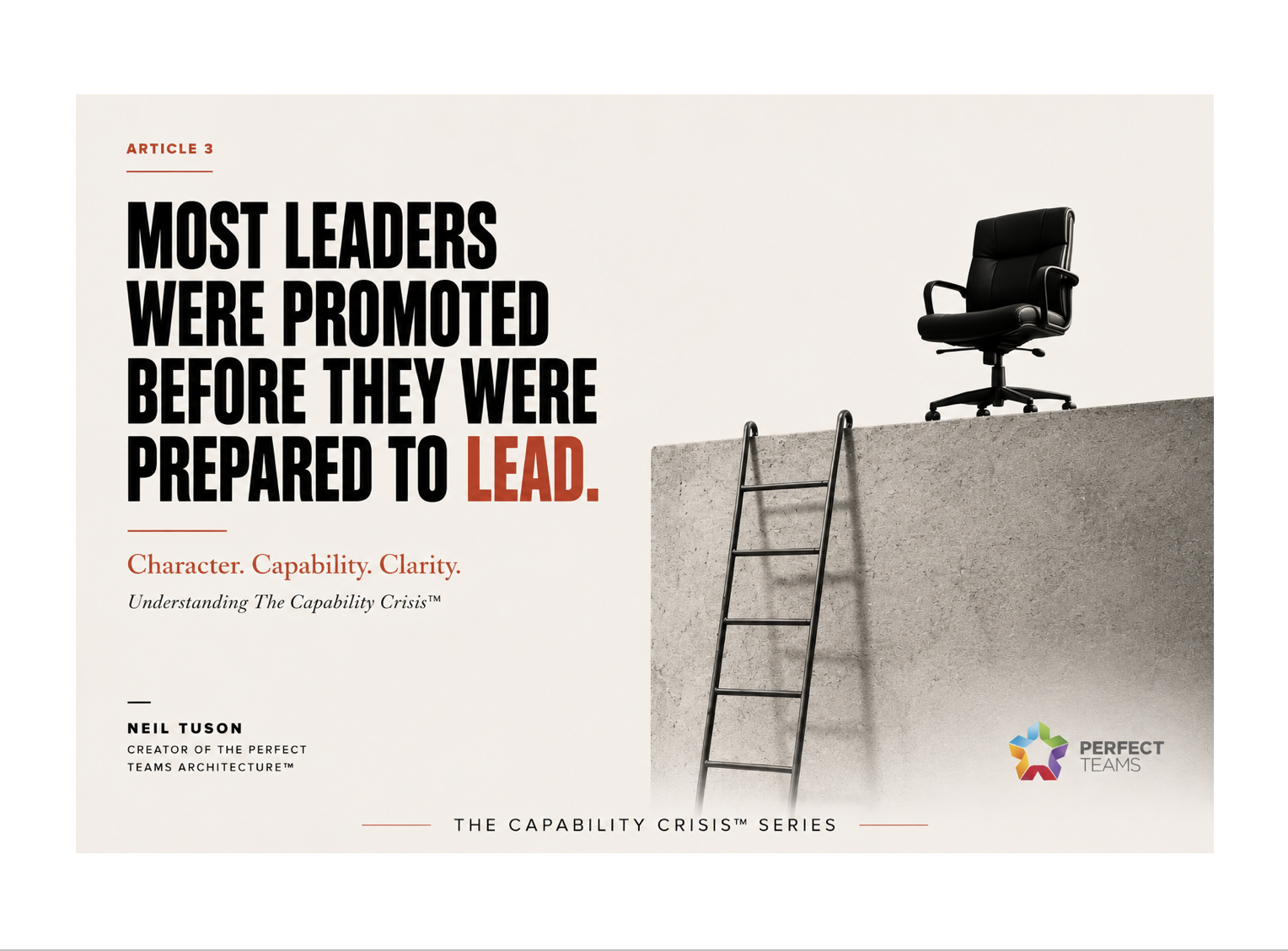
Most leaders were promoted before they were prepared to lead.
Think about that for a moment.
We spend years preparing people for technical competence.
Then one day, we promote them into leadership and hope for the best.
The engineer becomes the engineering manager.
The salesperson becomes the sales director.
The accountant becomes the finance director.
The founder becomes the CEO.
And suddenly they are expected to motivate people, navigate conflict, communicate a vision, build trust, make difficult decisions and create a culture in which others can thrive.
The problem is that technical competence and leadership capability are not the same thing.
One gets you promoted.
The other determines whether people follow.
And that, I believe, is one of the clearest manifestations of The Capability Crisis™.
Not a crisis of intelligence.
Not a crisis of effort.
A crisis of leadership capability.
The Great Promotion
For decades, organisations have rewarded people for being good at what they do.
This seems logical.
The best teacher becomes the headteacher.
The best consultant becomes the managing partner.
The best operator becomes the operations director.
But leadership requires a different set of capabilities.
The ability to influence rather than instruct.
To persuade rather than control.
To develop people rather than simply direct them.
To think beyond today’s task and see tomorrow’s possibilities.
Many organisations assume these capabilities will emerge naturally.
Sometimes they do.
Often they don’t.
Which is why so many leaders feel overwhelmed by the very role they worked so hard to achieve.
Leadership Is Not a Position
One of the great misconceptions about leadership is that it comes with a title.
It doesn’t.
A title creates authority.
Leadership creates followership.
The two are not the same thing.
Robert Greenleaf, the founder of the servant leadership movement, told the story of a servant who quietly held an expedition together.
Nobody paid much attention to him.
Until he disappeared.
The group descended into confusion and conflict.
Only later did they discover that the servant had been the real leader all along.
It’s a simple story.
But it reveals something profound.
Leadership is often invisible until it is absent.
The best leaders frequently spend less time drawing attention to themselves and more time helping others succeed.
And perhaps the highest expression of leadership is this:
Developing people who become increasingly capable without you.
Crisis Reveals Capability
One of my earliest lessons in leadership came during a team-building exercise.
The challenge was to prevent a simulated nuclear core meltdown using a collection of objects and a strict set of rules.
I immediately saw the solution.
The problem was that nobody was listening.
While the group continued discussing the options, I acted.
The problem was solved.
The feedback session that followed was less enthusiastic.
I was criticised for not being a team player.
Yet my perspective was shaped by my background as a marine engineer.
When there is a fire in an engine room, you don’t form a committee.
You act.
The lesson stayed with me.
Not because I was right.
But because it highlighted an important truth.
Different situations require different leadership capabilities.
In a crisis, we value decisiveness.
During growth, we value vision.
During consolidation, we value discipline.
During transformation, we value courage.
There is no universal leadership style.
There are capabilities that become more or less valuable depending on the circumstances.
Leadership or Management?
Perhaps the most important question is this:
Are we leading?
Or are we managing?
The two are often confused.
Management is about maintaining what already exists.
Leadership is about taking people somewhere they would not have gone on their own.
Management creates stability.
Leadership creates movement.
Both matter.
Both are necessary.
The mistake is assuming they are the same thing.
Many organisations call people leaders when what they really need are managers.
Others appoint managers when what they desperately need are leaders.
The capability required depends on the challenge.
The Capability Crisis™
One of the recurring themes throughout this series is that capability determines what becomes possible.
Leadership is no exception.
The world is not short of intelligent people.
Nor is it short of ambitious people.
What it increasingly lacks is people who have deliberately developed the capabilities required to lead.
The ability to build trust.
To communicate clearly.
To handle uncertainty.
To make difficult decisions.
To inspire confidence.
To create momentum.
To bring out the best in others.
And ultimately:
To develop capability in others.
These are not personality traits.
They are capabilities.
And capabilities can be developed.
Which brings us back to where we began.
Most leaders were promoted before they were prepared to lead.
Not because they lacked intelligence.
Not because they lacked potential.
But because nobody had shown them how.
And perhaps that is one of the most important manifestations of The Capability Crisis™ today.
Five Things Worth Remembering
- Leadership is not a position. A title creates authority; leadership creates followership.
- Technical competence ≠ Leadership capability.
- Different situations require different leadership capabilities.
- Management creates stability. Leadership creates movement.
- The highest expression of leadership is developing capability in others.
The Capability Crisis™
Neil Tuson is exploring why people, organisations and societies increasingly struggle, not because they lack intelligence, but because the capabilities required to create progress are rarely recognised, deliberately developed or consistently rewarded.
Character. Capability. Clarity.
Originally published 16 July 2026. Updated August 2026.
 Article by: