

The Capability Crisis™
You can’t download capability.™
The Eight Human Capabilities You Can’t Download
What will make you valuable in the age of AI?
We are living through an extraordinary paradox.
Never before has so much knowledge been available to so many people, so quickly.
Artificial Intelligence can find information, analyse data, generate ideas, write reports, create presentations and answer questions in seconds.
And it is only going to get better.
So where does that leave us?
I think we’ve been asking the wrong question.
The debate tends to focus on what AI will be capable of doing.
Perhaps we should spend more time asking:
What will human beings need to be capable of doing?
Because knowledge and capability are not the same thing.
Knowledge tells us what to know.
Capability determines what we can do.
And that distinction may become increasingly important as knowledge becomes abundant.
The Capability Crisis™
Earlier this year, a business owner asked me a question that crystallised something I’d been thinking about for a long time.
He was frustrated by the young people he was encountering in the workplace.
They were intelligent. They had qualifications. They were comfortable with technology.
But, he said, many struggled to speak confidently, build relationships, pick up the telephone, meet people face-to-face and network.
His question was simple:
“Surely you must have a course that can help?”
I did.
In fact, I’ve spent much of my working life helping people develop precisely these kinds of capabilities.
The conversation also crystallised something much bigger for me.
We don’t have a shortage of knowledge.
We may have a shortage of capability.
I call it The Capability Crisis™.
And AI isn’t creating it.
AI is exposing it.
What do employers actually need?
Recently, an HR Director from a major insurance company gave me her own view of what young people increasingly need in the workplace.
She talked about initiative.
Responsibility.
The confidence to share ideas and ask questions.
The resilience to cope with competition, setbacks and criticism.
And the ability to communicate effectively and build successful careers.
These aren’t things you acquire simply by reading another book or watching another video.
You have to develop and build them.
So, what are the human capabilities that will increasingly distinguish us?
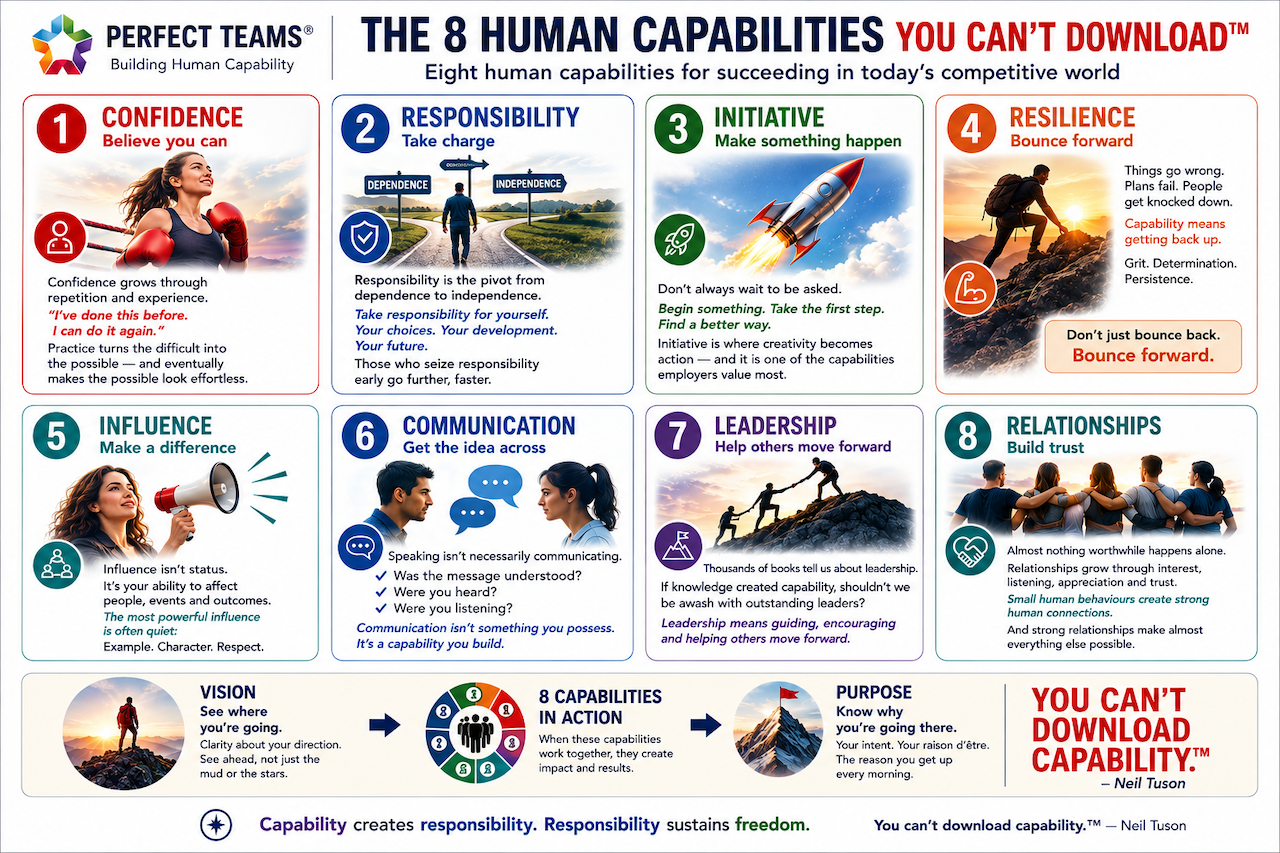
Here are eight that I believe matter enormously.
- Confidence — Believe you can
Confidence changes what becomes possible.
Without it, even relatively simple things can feel difficult. With it, we become willing to step forward, speak, contribute and attempt things we haven’t done before.
But confidence isn’t something somebody simply gives you.
It grows through repetition and experience.
I’ve done this before.
I can do it again.
Behind apparently effortless capability there are often hours or years of unseen practice.
Confidence is built by doing.
- Responsibility — Take charge
For me, responsibility is the pivotal capability, the crux issue.
It represents the movement from dependence towards independence.
Am I taking responsibility for myself?
My choices?
My commitments?
My money?
My development?
My future?
It is the perennial question asked by parents everywhere:
When are they going to stand on their own two feet?
The same principle applies in organisations.
People who take responsibility don’t simply wait for circumstances to improve. They begin taking charge of the things they can influence.
Those who seize responsibility early tend to go further, faster.
- Initiative — Make something happen
Employers value initiative enormously. To them it is the ‘Golden Egg’.
Why?
Because initiative is the moment somebody stops waiting to be told what to do and makes something happen.
Begin something.
Take the first step.
Ask whether there’s a better way.
This is also where creativity starts to become useful.
Ideas on their own don’t change very much.
Initiative turns ideas into movement.
It has the essence of the new about it: fresh, energising and sometimes disruptive.
The question is:
Where could I show more initiative?
- Resilience — Bounce forward
Things go wrong.
Plans fail.
People get criticised, rejected, disappointed and knocked down.
Capability doesn’t prevent those things happening.
It determines what happens next.
The Finns have a wonderful concept: Sisu.
Grit. Determination. Persistence in the face of insurmountable odds.
We normally talk about the ability to “bounce back”.
I prefer:
Bounce forward.
Get up. Learn something. Adapt. Continue.
If responsibility is the pivot of capability, resilience is the enduring thread running through it.
- Influence — Make a difference
Influence is often misunderstood.
It isn’t status.
It isn’t volume.
And it isn’t necessarily persuasion.
Influence is our ability to produce an effect on people, events and outcomes.
Think about the people who have influenced you most profoundly.
They may never have deliberately tried to persuade you of anything.
Their influence may have come quietly through:
Example. Character. Respect.
The question isn’t whether you have influence.
We all do.
The better question is:
What are you doing with it?
- Communication — Get the idea across
We can transmit a message around the world seven times in one second. But it can take a lifetime to go that last millimetre.
Because we’ve sent the message doesn’t mean we’ve communicated.
Communication happens when an idea gets from one human being to another clearly and without misunderstanding.
Was the message understood?
Were you heard?
Were you listening?
Was the other person actually open to what you were saying? Were they open, unbiased, and really listening?
Communication touches almost everything we do: presentations, meetings, telephone calls, conversations, networking, public speaking and those first few moments when we walk into a room full of strangers.
It isn’t simply something you possess.
Communication is a capability you build.
- Leadership — Help others move forward
Tens of thousands of books have been written about leadership.
Which raises an interesting question.
If knowledge created capability, shouldn’t we be awash with outstanding leaders by now?
Knowing about leadership isn’t the same as being able to lead.
I prefer a pragmatic definition.
Leadership is the ability to guide, steer, encourage, show the way and bring forth something in others.
It isn’t about being the big “I AM”.
At its best, leadership is about helping.
Sometimes from the front.
Sometimes from behind.
Leadership becomes visible when other people move forward because of what you did.
And perhaps its highest expression is developing people who become increasingly capable without you.
- Relationships — Build trust
Almost nothing worthwhile happens alone.
Our ability to build relationships may therefore be one of the most enduring human capabilities of all.
Relationships are built on trust and an absence of fear.
And they are often created through remarkably small things:
Smiling.
Remembering someone’s name.
Being genuinely interested.
Listening.
Showing appreciation.
These apparently minor human behaviours create connection.
Over time, connection creates trust.
And strong relationships make almost everything else possible.
Vision and Purpose
Together these two ideas top and tail the eight capabilities and give them energy and direction.
Vision asks: Where am I going?
Can I see ahead?
Am I clear about the future I’m trying to create?
Or, as I sometimes put it, do I see the mud or the stars?
Purpose asks: Why am I going there?
What is my intent?
My raison d’être?
What is the underlying beat I’ve been marching to throughout my life?
Vision gives us somewhere to go.
Purpose gives us a reason to go there.
The eight capabilities help us make the journey.
A different competitive advantage
For much of our lives, knowledge provided competitive advantage.
If you knew something other people didn’t, that knowledge had value.
AI changes that equation.
Increasingly, enormous quantities of knowledge will be available to almost everyone, almost instantly.
So perhaps the defining question is changing.
It is becoming less:
What do you know?
And more:
What are you capable of doing with what you know?
Can you step forward confidently?
Can you take responsibility?
Can you show initiative?
Can you recover from setbacks?
Can you influence?
Can you communicate?
Can you lead?
Can you build relationships?
And do you have sufficient vision and purpose to know where you’re going and why?
These aren’t “soft skills”.
They are deeply human capabilities.
As the HR Director above said, “We’re looking for demonstrable evidence of someone standing out. Have they run the London marathon, done the Duke of Edinburgh awards, or been involved in a local community initiative?”
We develop these capabilities through challenge, experience, practice, responsibility, reflection and action.
And in a world in which machines can increasingly provide the knowledge, those human capabilities may become more valuable, not less.
Technology will continue to change what is possible.
Human capability will determine what we do with those possibilities.
Capability creates responsibility. Responsibility sustains freedom.
And there is one thing worth remembering as we race into the age of Artificial Intelligence:
You can’t download capability.™
— Neil Tuson
 Article by: