
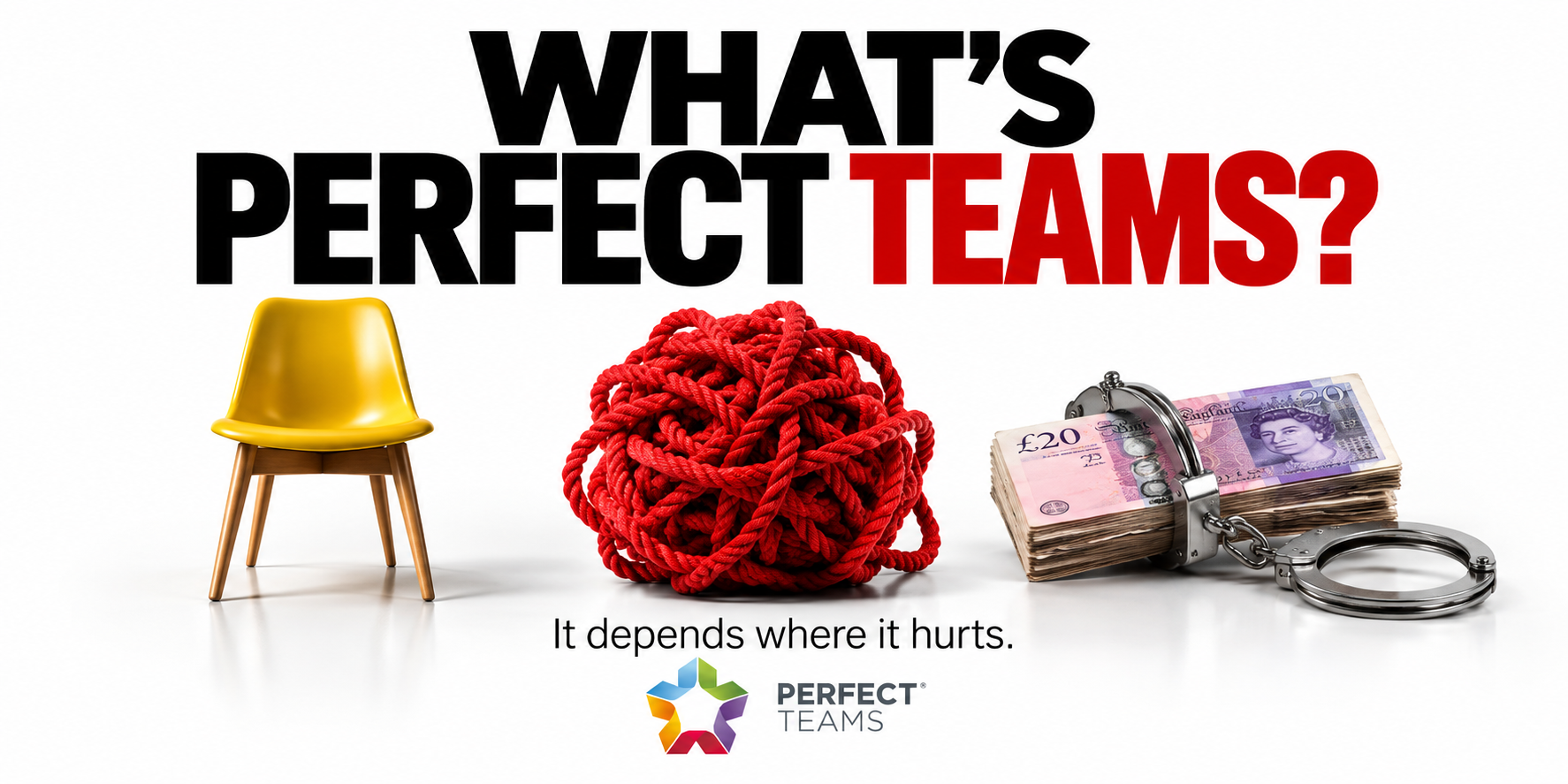
What’s Perfect Teams?
Where does it hurt?
If you went to the doctor’s and she started your appointment by telling you about her qualifications, the specialist courses she’d attended, and her knowledge of orthopaedics, cardiovascular disease, oncology and respiratory conditions, you wouldn’t be impressed, would you?
You’d probably feel rather miffed.
After all, you booked the appointment because you had something you needed advice on.
On the other hand, if she started by asking:
“Where does it hurt?”
you’d know she was interested in you.

We’re not doctors. But we take much the same approach.
That’s probably an odd way to begin an article about a business.
But it’s increasingly how I think about Perfect Teams.
Because nobody wakes up in the morning thinking:
I need a character-based human capability system.
They wake up thinking:
- I need a job.
- These people are driving me mad.
- I’ve built a successful business, but I haven’t got a life.
Very different problems. Or are they?
When we ask, “Where does it hurt?”, we’re interested in where the pain actually is.
For the young person trying to get onto the first rung of the career ladder, or earn their first promotion.
For the team leader tearing their hair out at the never-ending business of dealing with people.
Or for the business owner or executive thinking:
“I didn’t sign up for this. I’m making money but don’t have the time or energy to enjoy it. Is this it? Surely there’s more to life than this perpetual merry-go-round?”
For a young person leaving education, the immediate problem is obvious.
They want someone to give them a chance.
Qualifications matter. Knowledge matters. Technical skills matter.
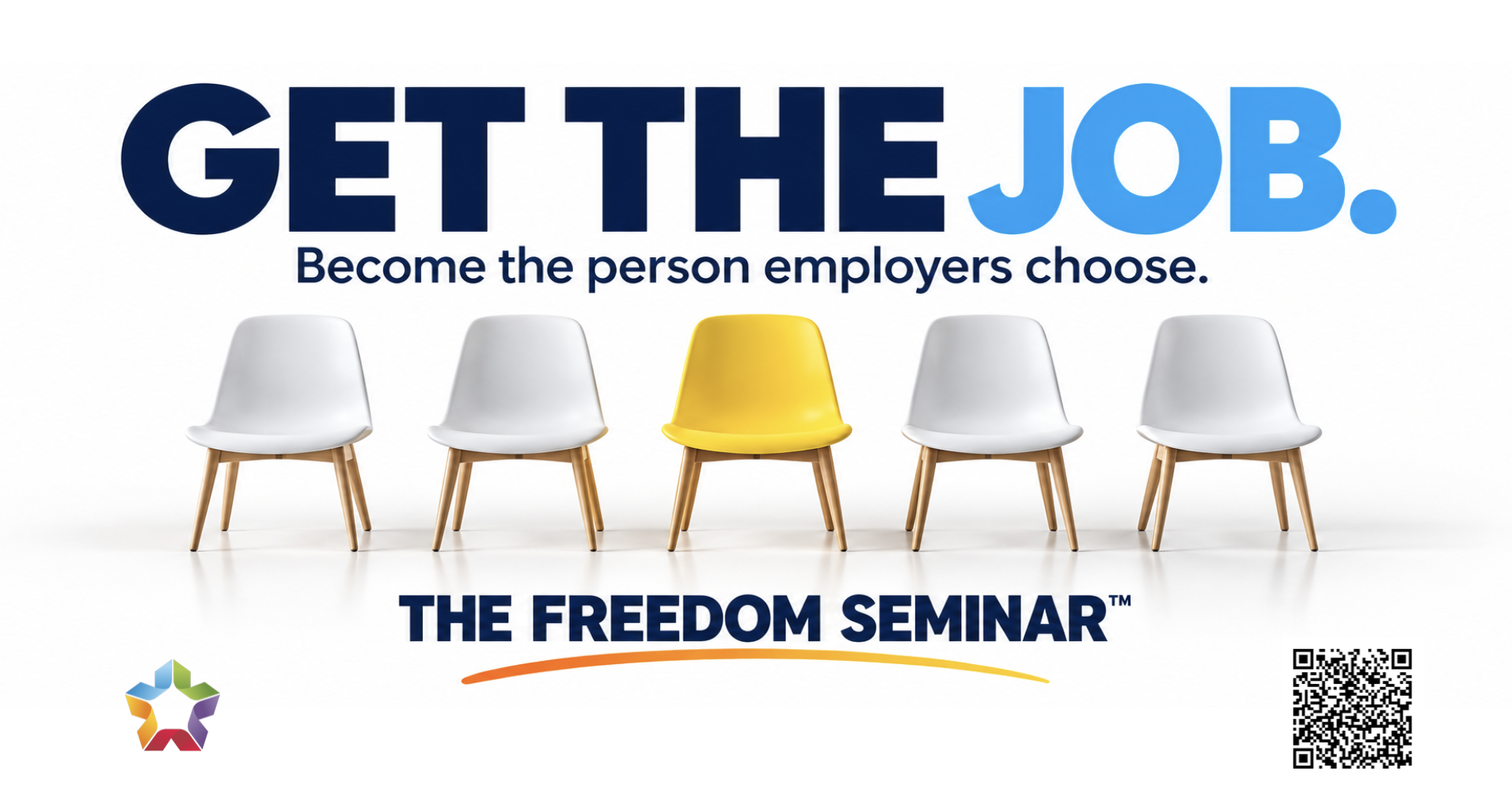
But when several people can do the job, what makes an employer choose one of them? What makes them stand out? What is the demonstrable difference?
It will be confidence, communication, initiative, responsibility, and resilience. The ability to build relationships, paint a picture of where they want to be and why it’s important to them.
In other words, human capability.
That is the territory of The Freedom Seminar™.
Not simply helping somebody get a job, but helping them become the person employers choose. They will be able to demonstrate to their potential employer that they don’t have ‘Soft-Skills’ they have ‘Hard-Capabilities’.
Then we enter the world of work.
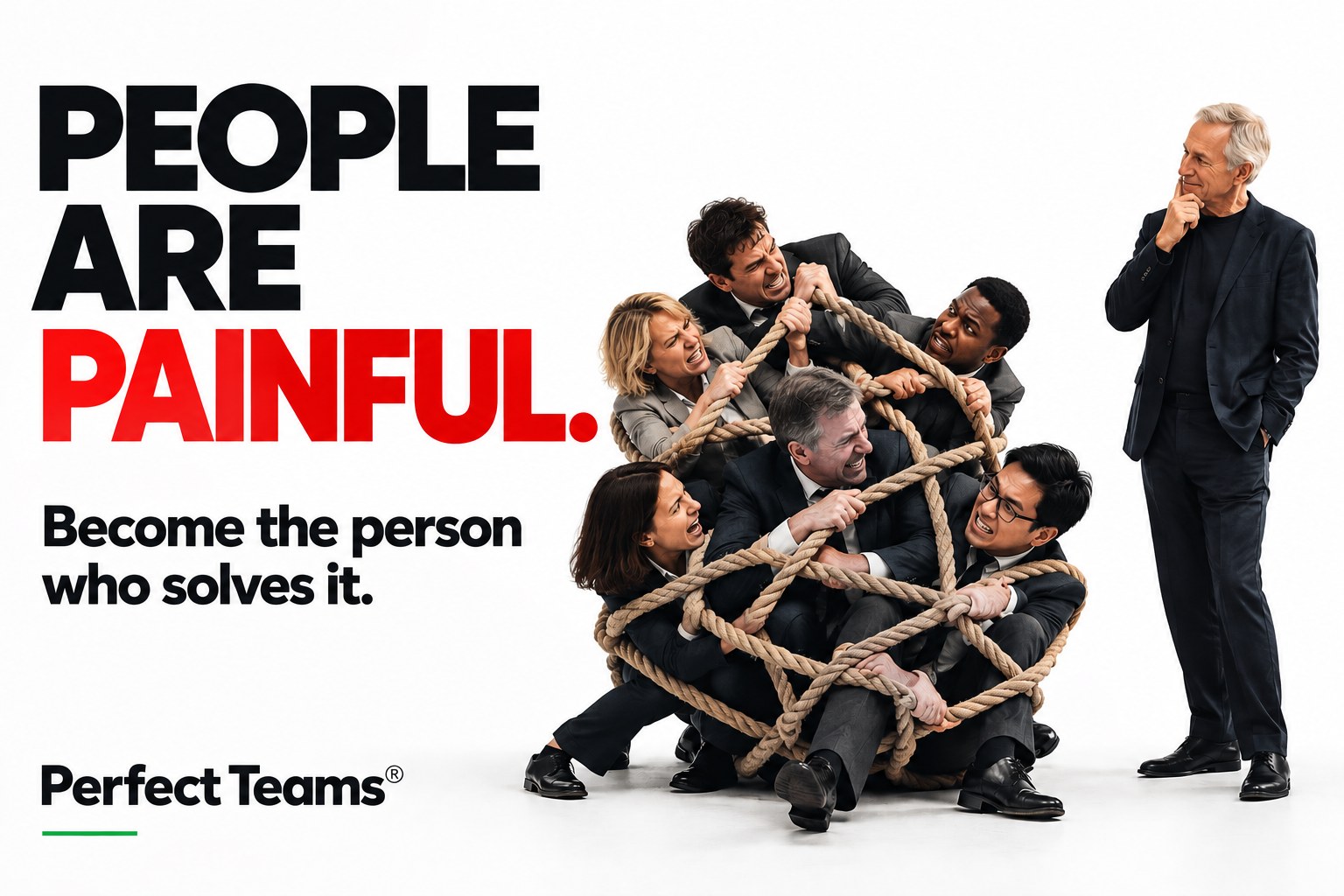
And discover people.
The wrong hire.
The colleague nobody can work with.
The talented team that somehow doesn’t perform.
The same argument you’ve settled three times already.
Most organisations don’t have a shortage of people.
They have difficulty understanding the people they’ve got.
This is where Perfect Teams began.
We make character visible.
Profile the individual.
Map the team.
Spot what’s missing.
See where the friction comes from.
Start the conversation.
Personality describes how somebody appears.
Character helps explain what lies underneath.
Once you can see that, people become a little less painful.
Then there’s another problem.
Success.
You build the business.
More customers. More people. More revenue. More responsibility.
Eventually you can find yourself owning something valuable that cannot function properly without you.
You spend your time making money.
Then discover you’d pay money to get your time back.
That’s where Scale-As-A-System™ enters the picture.
The question changes from:
How do I grow this business?
to:
How do I make the business worth more while making it need me less?
Again, underneath the business problem sits a capability problem.

Three problems. One underlying issue.
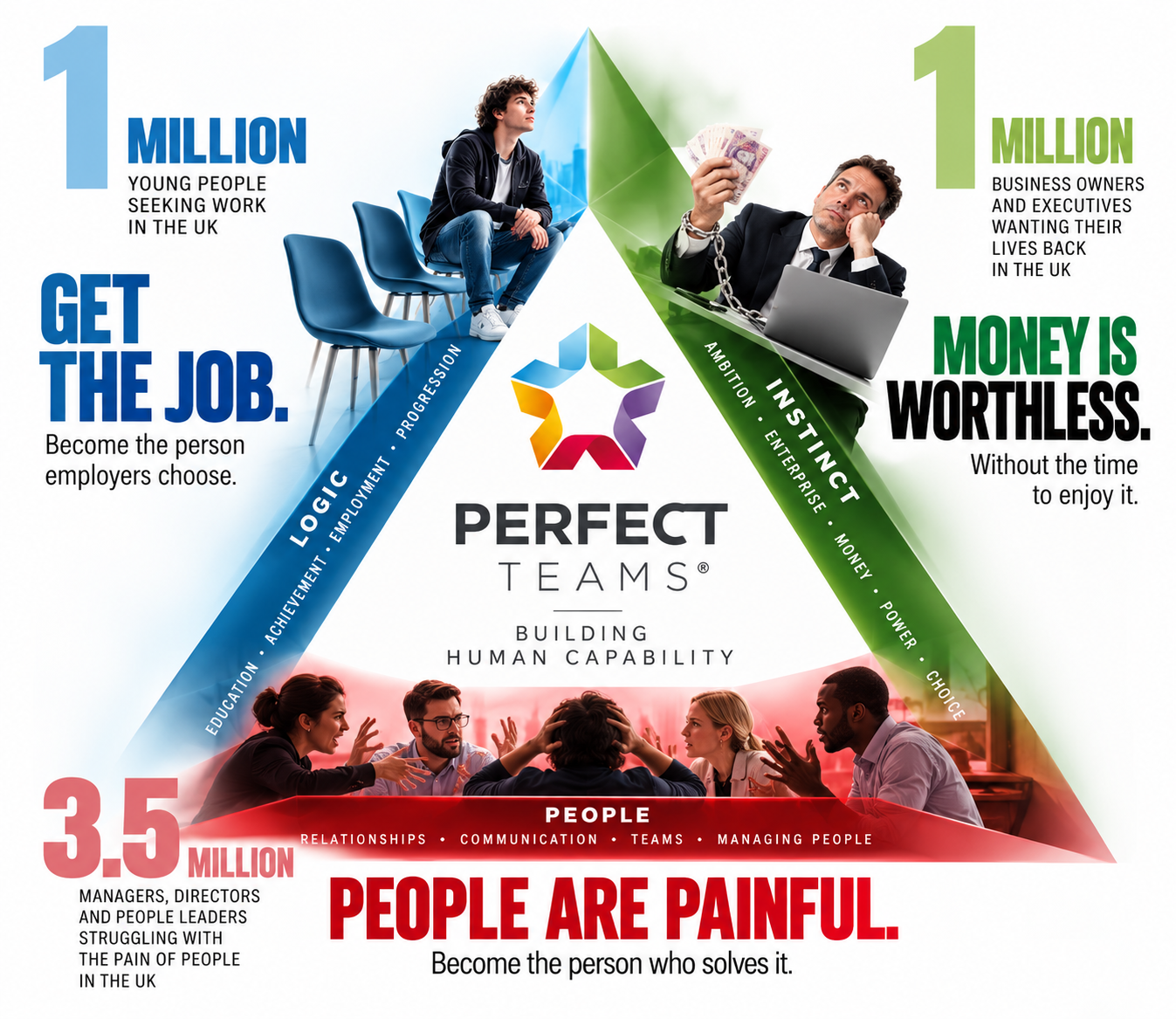
GET THE JOB.
PEOPLE ARE PAINFUL.
MONEY IS WORTHLESS.
They look like three very different problems.
They’re not.
They’re three places where the same underlying issue becomes visible.
Human capability.
And that’s the simplest answer I can now give to the question:
So, what’s Perfect Teams?
Perfect Teams® is a system for Building Human Capability.
It helps individuals understand themselves.
It helps people understand each other.
It helps teams see what’s missing.
It helps leaders see what’s getting in the way.
And it helps businesses become more capable of moving forward without everything depending upon one person.
The tools vary because the problems vary.
The underlying question doesn’t:
What would become possible if the people involved were more capable?
It Started With Character
Perfect Teams started with character. Not personality.
Not “What type are you?” for the sake of putting another label on somebody.
Character as a practical way of understanding why different people see the world differently, contribute differently and need different things from one another.
But over time I realised character was only part of the story.
Character affects capability.
Capability affects what becomes possible.
And what becomes possible determines the degree of independence and freedom we can create.
Which is why Perfect Teams today is bigger than a profiling tool.
The profile is one instrument.
The Team Map is another.
The Freedom Seminar™ is another expression.
Scale-As-A-System™ is another.
They all sit inside the same architecture.
Building Human Capability.
Where does it hurt?
And that brings us back to where we started.
Perhaps you need the opportunity.
Perhaps people are the problem.
Perhaps you’ve got the money but would quite like your life back.
Different problems.
Different people.
Different stages.
But perhaps the question is the same:
What’s stopping you moving forward?
Because knowledge has never been more available.
AI can increasingly give us information, answers and expertise almost instantly.
But knowing isn’t doing.
And information isn’t capability.
You can’t download capability.™
First published September 28th 2026.
 Article by: