

Dependency & The Capability Crisis™
Who’s Going to Do It for You?
My father had a wonderful description of people who expected the world to provide for them.
He called it the Maltese Breaststroke.
He’d thrust his arms forward and sweep them dramatically towards his chest, repeating:
“Give it to me! Give it to me!”
He was referring to Dom Mintoff, the Maltese Prime Minister, back in the seventies.
I’ve never forgotten it.
And the older I get, the more I wonder whether we’ve turned the Maltese Breaststroke into an Olympic sport.
Everyone wants something.
A better job. More money. Greater security. Recognition. Happiness. Freedom.
Nothing wrong with any of those ambitions.
But often they want that something for nothing.
So, who’s going to make those ambitions happen? And who’s going to pay?
Your parents? Your employer? The government? The education system? Somebody with a training budget?
And what happens if nobody turns up?
Many years ago, I lived in California and worked for York International.
I paid $1,200 of my own money to attend a fourteen-week Dale Carnegie evening course. A substantial investment at the time.
Nobody sent me. Nobody sponsored me. Nobody promised me a promotion.
I simply wanted to become better at what I did.
When I returned to Britain and began building a Dale Carnegie business in South London, I encountered something that has puzzled me ever since.
People were perfectly happy to attend training.
Provided somebody else paid.
I can still remember the handful of people who invested their own money: Jonathan Butterworth, Nic Rixon, and Peter Baker. In years to come, Roman Marszalek and Gerald Peoples would join what I call my one-hand club.
They weren’t buying a certificate.
They were investing in people they hadn’t yet become.
Jim Rohn, the American entrepreneur and philosopher, made a wonderfully simple distinction between the value you bring to the marketplace and the value you become.
The first is what you do, make, sell or provide to make a living. Work hard on doing this.
The second is what you develop within yourself. Work harder on this in the extra time you have.
Your knowledge, your judgement, your confidence, your initiative, your ability to influence, communicate and solve problems will make things happen.
The value you become can be worth a fortune.
You can spend your life waiting for somebody to recognise your value. Or you can spend it becoming more valuable.
Which brings me to a rather uncomfortable question.
When did you last invest your own time, money or effort in becoming someone you weren’t yesterday?
And if you haven’t, why not?
The dependency trap
Dependency is perfectly natural.
We arrive in this world entirely dependent on others. Throughout our lives, illness, disability, age and misfortune may require us to depend on other people again. I’ve recently broken my shoulder, and I am acutely aware of my dependency on others to help me.
That’s not the problem.
The problem arises when dependency ceases to be a necessary condition and becomes a preferred way of life.
You can immediately recognise dependency when waiting replaces initiative, entitlement replaces contribution, and those perpetual excuses replace action.
It’s when somebody else is expected to assume responsibility for a life that belongs to us.
And here’s the uncomfortable part.
We don’t merely tolerate dependency. Sometimes we encourage it.
Parents who never allow their children to struggle.
Managers who solve every problem rather than develop the people who could solve it.
Employers who complain about the lack of initiative while punishing anyone who demonstrates it.
Institutions that measure the assistance they provide but not the independence they help create.
Governments that sometimes find it easier to administer dependency than to develop capability.
These issues of systemic dependency are writ large across society.
Of course, some people face genuine barriers that cannot be overcome by positive thinking or determination alone. They need practical help, fair opportunities and sometimes sustained support.
But surely the ultimate ambition of that support should be to increase people’s ability to exercise choice wherever and whenever possible?
The purpose of helping people should be to increase their capability, not merely to manage their dependence.
That is a very different philosophy of help.
Are we manufacturing dependency?
Here’s a question that ought to make us uncomfortable.
What happens when we spend eighteen years educating someone, then discover we haven’t prepared them to make their own way in the world?
We give young people knowledge. We give them examinations. We give them qualifications.
And then we expect them to find work, make decisions, take responsibility, handle rejection, show initiative, communicate effectively and become economically independent.
But where did we deliberately develop those capabilities?
Britain has a substantial number of young people who are not in education, employment or training. We call them NEETs.
Others have argued that we should pay more attention to those who are looking for education, employment, or training. LEETs.
Fair enough.
But perhaps there’s a question that comes before either label.
Are we developing young people who are capable of becoming either?
Employers complain about young people’s lack of confidence, initiative, communication and resilience.
Young people complain that employers demand experience they haven’t had the opportunity to acquire, and one memorably said, “We are not NEETS; we are DEETs—Desperate for education, employment, or training!”
Somewhere between education and employment, an extraordinary number of people struggle to make the transition.
Of course, the reasons are complex. Economic conditions, health, family circumstances, geography and opportunity all matter. Not every difficulty is a failure of individual capability.
But surely developing the capabilities needed to navigate those difficulties ought to be one of our highest priorities?
Because the longer someone remains outside work, education and meaningful participation, the harder the journey towards independence can become.
And there’s a terrible irony in this.
We may be spending more time managing the consequences of dependency than developing the capabilities that could help prevent it.
Which raises a question for every parent, teacher, employer and policymaker.
Are we preparing young people for the world as it is?
Or simply hoping they’ll work it out when they get there?
Because preparing people for life ought to involve more than preparing them for examinations.
When we fail to build capability, we risk manufacturing dependence.
It’s one of the reasons I developed The Freedom Seminar™, an eight-week apprenticeship in human capability. Not to give young people more answers, but to help them develop the confidence, responsibility, initiative and resilience to find their own.
The story we tell ourselves
There’s another form of dependency that doesn’t appear in government statistics.
It’s the story we tell ourselves.
I can’t.
It’s not my fault.
They won’t let me.
Someone ought to do something.
If only things were different.
Some of those statements may be perfectly accurate.
But accuracy doesn’t necessarily make them useful.
An explanation of why something happened is not always a reason to do nothing about it.
Years ago, I began developing a simple philosophy that eventually became XVBE.
No Victims. No Blame. No Excuses.
Not a denial that people suffer injustice.
Not an invitation to blame those who have been hurt.
And certainly not a suggestion that everyone begins life with the same opportunities.
It’s a refusal to allow what has happened to us to dictate everything that happens next.
Being a victim of an event is one thing.
Allowing victimhood to become the permanent organising principle of your life is quite another.
Blame may explain the past.
Excuses may explain the present.
Neither builds the future.
And that’s where something remarkable becomes possible.
The moment of choice
In 1994, I published a little book called The A–Z of Positive Thinking.
At its heart was a simple observation.
We cannot always choose our circumstances. But we can often choose how we respond to them.
I was particularly influenced by Viktor Frankl’s reflections on the fact that we have the freedom to choose our attitude in any situation, and George Bernard Shaw’s challenge to go out and create the circumstances we want.
Over the years, I developed a model I call the Three Spaces.
Dependence. Independence. Interdependence.
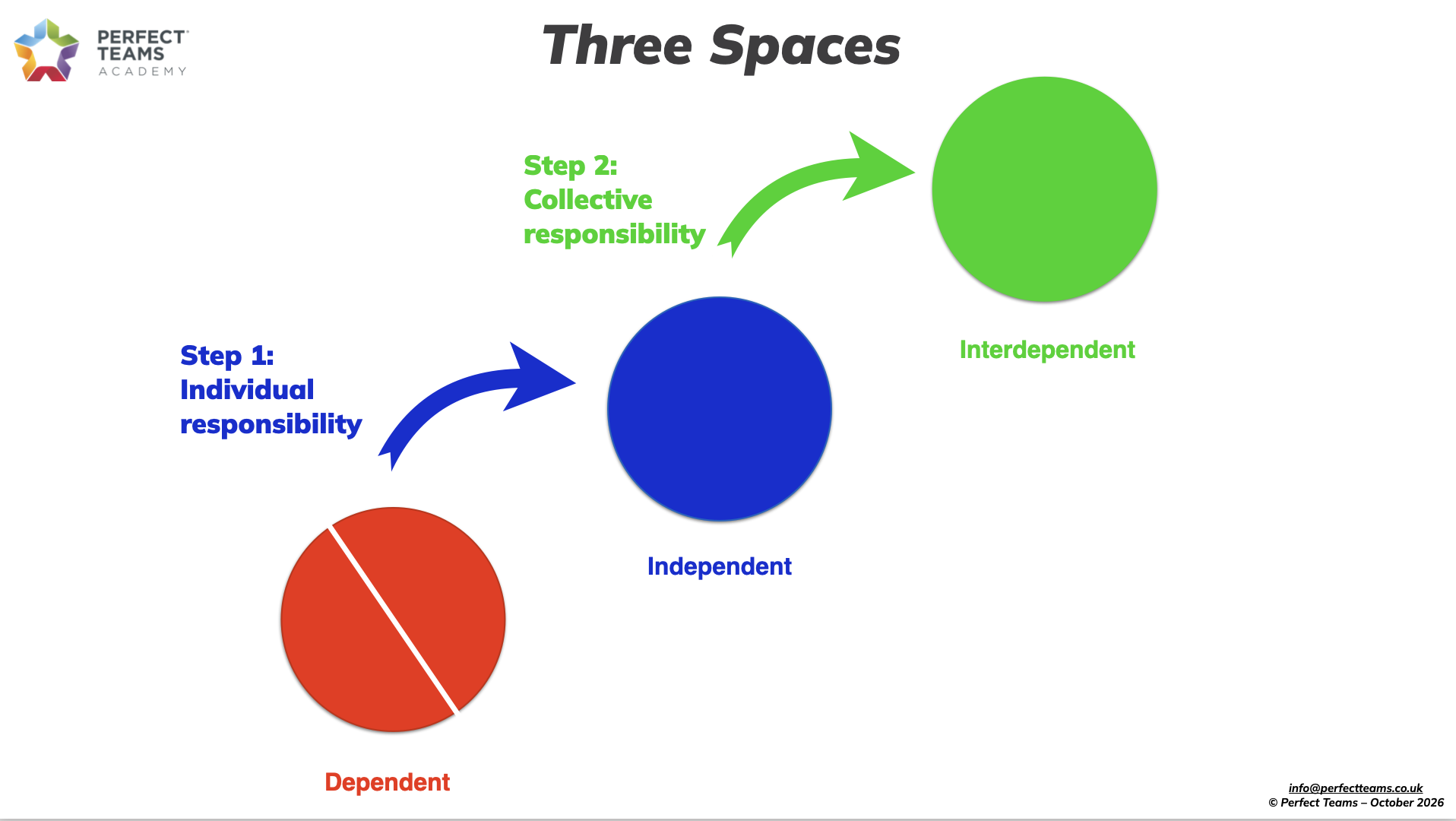
In the first space, to the left, we’re largely at the effect of circumstances. Move to the right, and we begin to take responsibility and develop agency.
In the second, we take responsibility, make choices, and influence outcomes. We begin to attract other independent people.
In the third, capable, independent people discover what they can achieve together.
The transition isn’t automatic.
It requires an act of will.
A decision.
Sometimes a very small one.
Make the telephone call.
Apply for the job.
Learn the skill.
Have the difficult conversation.
Ask for help.
Take the first step.
And then another.
This is where change happens.
Not next year. Not when the economy improves. Not when somebody gives us permission.
At source. In the choices we make now.
One decision won’t transform a life overnight. Nor will determination magically remove every obstacle.
But repeated decisions become actions. Actions become habits. Habits develop capabilities. And capabilities expand what becomes possible.
That’s how independence grows.
The Capability Crisis™
We’ve spent generations expanding access to knowledge.
We have more information, more qualifications, more technology and more ways of communicating than any generation before us.
And now artificial intelligence can deliver answers to questions we haven’t even thought of asking.
But answers aren’t action.
Information isn’t initiative.
Qualifications aren’t judgement.
And knowing what ought to be done isn’t the same as being capable of doing it.
That’s the heart of The Capability Crisis™.
The growing gap between what modern life demands of people and the capabilities we’ve deliberately developed to meet those demands.
We need people who can take responsibility.
People who can handle setbacks.
People who can communicate, influence, create, contribute and lead.
People who don’t simply ask what the world can give them, but what they can bring to the world.
John F. Kennedy expressed that challenge magnificently in his inaugural address: “Ask not what your country can do for you, but what you can do for your country.”
And I wonder whether we’ve lost sight of it.
Not because people are inherently less willing or less able than previous generations.
But because we’ve become extraordinarily good at providing answers, assistance and systems, without always asking whether we’re developing the human capability to use them.
Are we building a society of capable people, or becoming increasingly capable at managing a dependent society?
Who’s going to do it for you?
There’s a wonderful irony in all this.
The more independent we become, the more valuable we can become to other people.
Independence isn’t the destination.
Interdependence is where the real possibilities begin.
Capable people building capable teams.
Capable teams building capable organisations.
Capable organisations contributing to a capable society.
And a society that measures its success not merely by how much help it distributes, but by how many people it enables to stand, contribute and flourish.
That’s the world I’d like to see.
Not one without compassion.
Not one without support.
But one where compassion and support are directed towards developing human capability wherever possible.
There are two sides to this challenge:
To the individual: Stop waiting for somebody else to live your life and do it for you.
To society: Stop expecting people to become capable without helping them develop capability.
Neither excuses the other.
So, the next time you find yourself waiting for somebody to make something happen, perhaps ask yourself a different question.
Not “Who’s going to do it for me?”
But:
“What can I do about it?”
Because somebody has to make the first move.
Why not you?
Five Key Insights
- Dependence is a natural part of life. Remaining dependent when we could become capable is the problem.
- When we fail to develop people’s capability, we risk manufacturing the very dependence we’re trying to alleviate.
- The purpose of helping people should be to increase their capability, not merely to manage their dependence.
- Blame explains the past. Excuses justify the present. Responsibility, initiative and action create the possibility of a different future.
- Independence isn’t the destination. It’s the bridge to interdependence, where capable people contribute, collaborate and create greater freedom together.
Want to build greater human capability?
The Capability Crisis™ explores the growing gap between what modern life demands and the human capabilities we develop. Discover the thinking behind Building Human Capability at Explore Perfect Teams® →
Please don’t like this article.
Send it to someone who needs to read it.
That, after all, is distribution.
Neil Tuson
Building Human Capability
You Can’t Download Capability™
First published November 11th, 2026.
 Article by: