

How Do You Get in Front of the Right People?
For years, marketers told us:
Content is King.
So, we created content.
Articles. Blogs. Videos. Podcasts. Newsletters. Posts.
Then everybody else slavishly did it too.
And now AI can create more content before breakfast than most of us could once produce in a month.
Something has changed.
Content is no longer scarce.
Attention is.
You can write the finest article nobody reads.
Create the cleverest proposition nobody encounters.
Build the best product nobody knows exists.
Which raises a rather awkward question.
If nobody sees it, how good is it?
The problem has moved
I don’t think we have a content problem anymore.
We have a visibility problem.
But even visibility isn’t quite enough.
Going viral in front of 100,000 people who have no interest in what you do may be considerably less useful than being noticed by ten people who do.
Which brings us to relevance.
And perhaps a more contemporary version of the old marketing maxim:
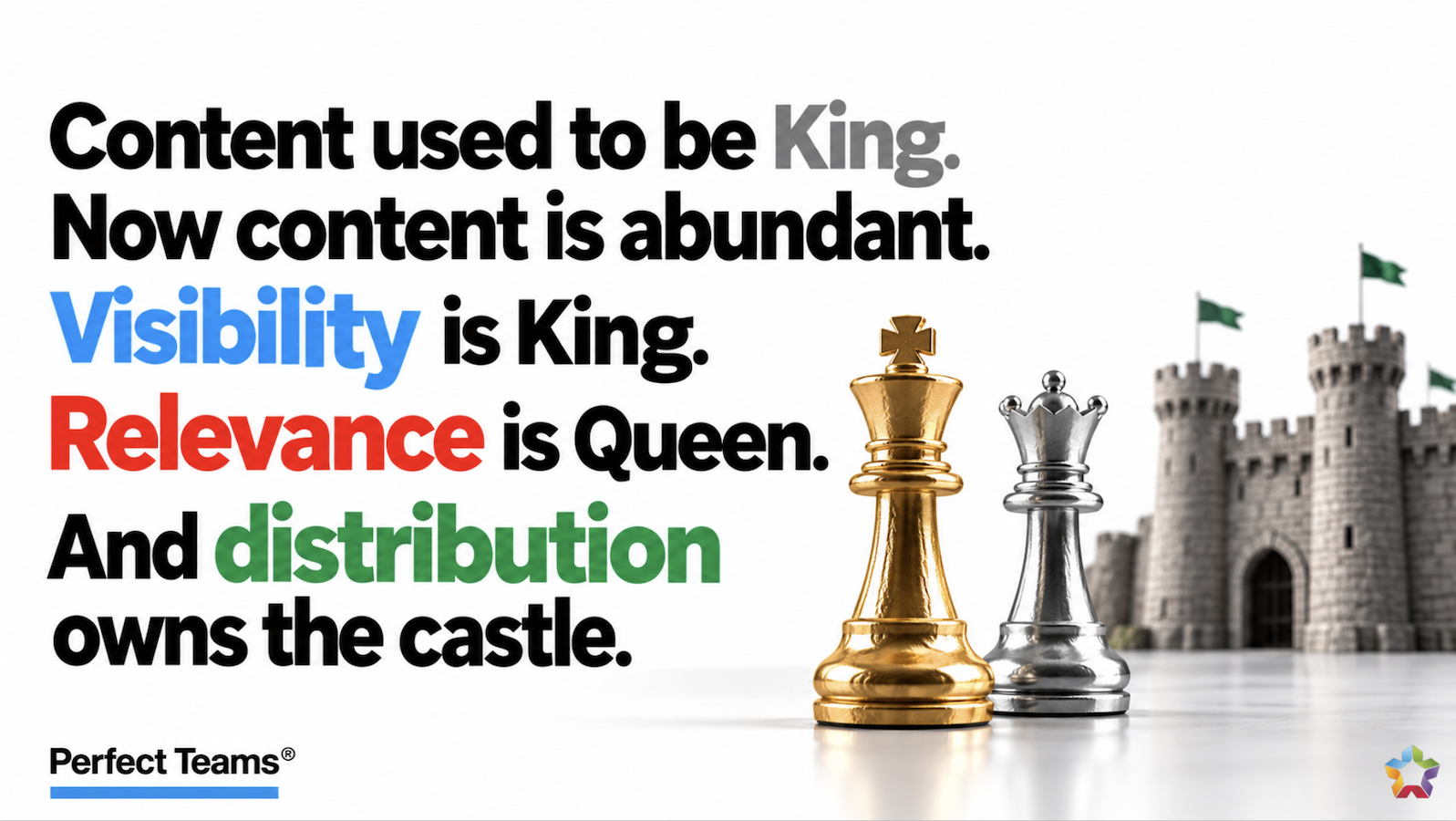
Content used to be King.
Now content is abundant.
Visibility is King.
Relevance is Queen.
And distribution owns the castle.
Because somebody has to get the message in front of the right people.
Ideas change the world. Distribution determines whether they get the chance.
Who are the right people?
This is the question I’ve become increasingly interested in.
Not:
How do I reach more people?
But:
How do I reach the people who matter?
That sounds slightly elitist until you think about it.
If you’re looking for a job, the right person might be an employer.
If you’re selling something, it might be a customer.
If you’ve developed a new idea, it might be someone with an audience.
If you’re trying to change an organisation, it might be the handful of people who are capable of making the decision.
We don’t need everybody’s attention.
We need the attention of the people for whom what we have to say is relevant.
And that changes the problem completely.
Stop building every audience from scratch
Here’s the bit I’ve been missing.
The people we want to reach are probably already gathered somewhere.
They read somebody’s newsletter and attend their conference.
Belong to an association.
Listen to a podcast and trust their judgement
Use somebody’s professional adviser.
In other words:
Somebody already has their attention.
So perhaps the quickest way to build an audience isn’t always to build one.
Perhaps it is to become useful to somebody who already has one.
Not by asking them to promote you.
That’s rarely very interesting to them.
But by giving them something that makes them more useful to their audience.
That’s a very different proposition.
The Right People Process
I’ve started experimenting with a ridiculously simple process.
Whenever I have something I want to get into the world, I ask five questions:
- MESSAGE
What is the one thing worth knowing? - PEOPLE
Who specifically needs to know it? - ACCESS
Who already has their attention? - RELEVANCE
Why would that person want to put it in front of them? - DISTRIBUTION
What could travel through their network without me continually pushing it?
The first question is about content.
The other four are about distribution.
That ratio may tell us something.
I’m testing it on myself
I’ve spent a considerable amount of time recently trying to answer two deceptively simple questions:
and:
It has taken rather more work than you might imagine.
But eventually the story became clearer.
My work is about Building Human Capability.
And Perfect Teams® exists to help individuals, teams, and organisations become more capable of moving themselves forward.
Fine.
The message is clearer.
But that creates another problem.
Who needs to know?
And more importantly:
Who already has their attention?
So, I’m mapping them.
Practitioners who already have clients.
Professional advisers who already have the confidence of business leaders.
People who run networks.
People who have audiences.
People who influence investment decisions.
People whose recommendation causes somebody else to pay attention.
Not because they’re famous.
Because they’re connected.
From content to conversation
There is another trap here.
Visibility isn’t the destination either.
Someone sees something.
Good.
Then what?
Ideally:
CONTENT → VISIBILITY → RELEVANCE → CURIOSITY → CONVERSATION → DISTRIBUTION
And if somebody finds the idea sufficiently useful to pass it on, something interesting happens.
Distribution creates more visibility.
Which creates more relevance.
Which creates more conversations.
It isn’t really a funnel.
It’s a flywheel.
And unlike advertising, a flywheel can begin with no money at all.
It needs something else.
A message worth passing on.
Which leaves me with a different question
For years I’ve asked myself:
What should I write next?
I’m beginning to think that’s the wrong question.
I’ve already written rather a lot.
Perhaps the better question is:
Who needs to see what I’ve already created?
Followed by the question that may matter even more:
Who already has their attention?
Because content may still be King.
But there are an awful lot of Kings around these days.
The interesting question for me is, ” Who owns the castle?”
Please don’t like this article.
Send it to someone who needs to read it.
That, after all, is distribution.
Neil Tuson
Building Human Capability
You Can’t Download Capability™
IDEAS CHANGE THE WORLD. DISTRIBUTION DETERMINES WHETHER THEY GET THE CHANCE.
Who owns the roads leading to the castle?
First published October 18th, 2026.
 Article by: