


Parchment or toilet paper: why most mission statements aren’t worth what they’re written on
Words on the wall don’t create direction. Clarity does.
“Most mission statements aren’t worth the paper they’re written on.”
Discuss.
It would make an interesting question on a management course.
But after decades of working with business owners and leadership teams, I’m less interested in the theory than in a more practical question:
Does yours actually make any difference?
Does anybody remember it?
Does it help people make decisions?
Does it tell them where the organisation is going?
Does it explain why that destination matters?
Does it influence what people actually do on Monday morning?
If not, perhaps it really isn’t worth the paper it’s written on.
VISION, MISSION AND PURPOSE AREN’T THE SAME THING
The words are often used interchangeably.
I think it helps to make them simpler.
Vision asks: Where are we going — and when?
Purpose asks: Why does it matter — and to whom?
Mission asks: What are we going to do — and how?
Where and When.
Why and Who.
What and How.
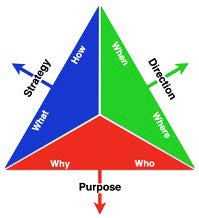
Those six questions have been part of the Perfect Teams® architecture for years.
And together they provide something most corporate statements don’t.
Clarity.
VISION GIVES US A DESTINATION
One of the clearest visions of the twentieth century came from President John F. Kennedy in 1961.
Put a man on the Moon and return him safely to Earth before the decade was out.
There was a Where.
There was a When.
People could picture the destination.
And they would know whether they’d reached it.
That’s very different from:
“To be the world’s leading provider of innovative solutions and exceptional customer experiences.”
Leading where?
By when?
What would it look like if we got there?
How would anybody know?
A vision should allow people to see a future that doesn’t exist yet.
PURPOSE ANSWERS WHY
But a destination isn’t enough.
People also need a reason to care.
Why does this matter?
Who benefits?
Why should I devote my energy to it?
We’ve used a simple expression at Perfect Teams® for years:
No why = no way.
Purpose provides the emotional connection between the destination and the people being asked to help reach it.
Without that connection, a vision can remain somebody else’s ambition.
MISSION TURNS INTENTION INTO ACTION
Then comes the practical part.
What are we actually going to do?
How are we going to do it?
What resources are required?
What capabilities do we need?
Who does what?
That’s mission.
It’s where aspiration meets execution.
And all three elements need one another.
Vision without mission is a dream.
Mission without vision is activity.
Neither will sustain people for long without purpose.
PARCHMENT OR TOILET PAPER?
Years ago, one of my contacts visited Enron’s offices after the company had collapsed.
He found a plaque displaying the company’s corporate statement.
Given what had happened, he promptly hung it in his toilet.
He told me:
“It was the only place it should be seen.”
The story has always amused me, but it makes a serious point.
Enron publicly espoused values including respect, integrity, communication and excellence.
Yet the company became synonymous with one of the great corporate scandals.
The problem wasn’t that the words weren’t impressive enough.
The problem was that the words and the behaviour had become disconnected.
A statement on a wall has no value if the organisation doesn’t have the character and capability to live it.
THE TEST ISN’T HOW GOOD IT SOUNDS
This is where organisations can get trapped.
A group of senior executives goes away for the day.
Words are debated.
A facilitator fills a flipchart.
Eventually everyone agrees upon an elegant sentence.
It goes on the website.
Perhaps somebody has it engraved in reception.
Job done.
Except nothing has changed.
The real test of a vision, mission or purpose isn’t whether the board likes the wording.
It’s whether it changes attention and behaviour.
Do people understand where they’re going?
Do they know why it matters?
Do they know what contribution they’re expected to make?
Can they use it to decide what to do — and what not to do?
That’s when words begin becoming useful.
CLARITY FOCUSES ATTENTION
In the previous article, we explored the idea that:
Motivation is about attention.
Vision and purpose help focus that attention.
A clear destination says:
Look there.
Purpose says:
Here’s why it matters.
Mission says:
Here’s what we’re going to do about it.
That’s considerably more useful than a paragraph of carefully crafted corporate language nobody can remember.
BUT THERE’S STILL SOMETHING MISSING
Even a brilliant vision, compelling purpose and clear mission don’t guarantee success.
The organisation still needs the capability to deliver them.
You can know precisely where you’re going.
You can care passionately about getting there.
You can have a beautifully constructed plan.
But do you have the right people?
The right character?
The right relationships?
The right judgement?
The right leadership?
The right collective capability?
That’s where the team enters the equation.
Because ultimately, organisations don’t achieve visions.
People do.
SIX SIMPLE QUESTIONS
So perhaps before commissioning another mission statement, put the existing one aside and ask your leadership team six questions:
Where are we going?
When will we get there?
Why does it matter?
Who does it matter to?
What are we going to do?
How are we going to do it?
If everybody around the table gives a different answer, you don’t have a wording problem.
You have a clarity problem.
And if everybody agrees on the answers but the organisation still can’t deliver them, you may have a capability problem.
That’s considerably more useful to know.
Because a mission statement should never merely describe an organisation.
It should help people build the future they’re trying to create.
Otherwise, parchment or toilet paper?
You decide.
You can’t download capability.™
Does your team have the capability to deliver your vision?
Perfect Teams® helps leaders understand the characters, strengths and gaps within their team — and whether they have the collective capability required to turn ambition into results.
Originally published 8 September 2021. Updated August 2026.
 Article by: