

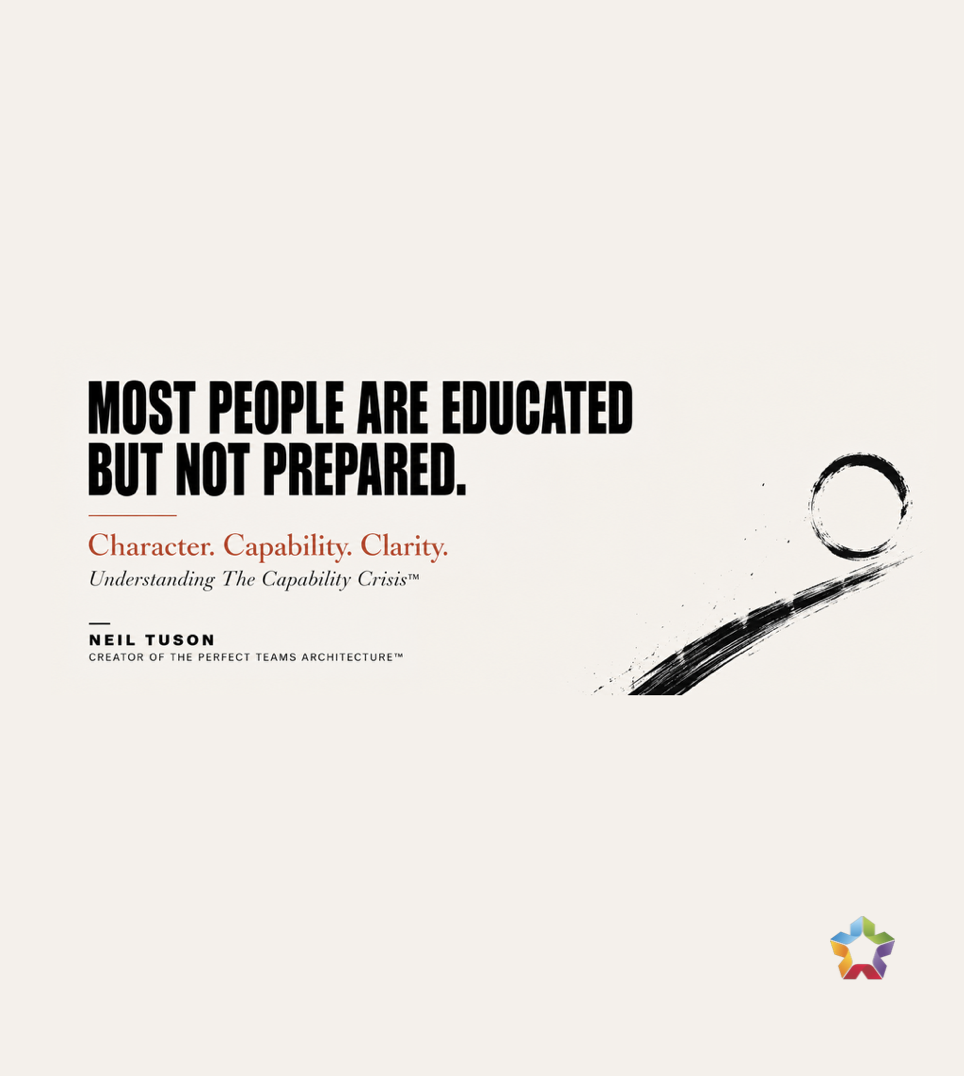
Confidence & The Capability Crisis™
MOST PEOPLE ARE EDUCATED AND INTELLIGENT
BUT NOT PREPARED.
That is not an attack on education.
It is an observation about modern life.
We have become extraordinarily good at transferring knowledge.
Less good at developing capability.
People leave school with qualifications.
University with information.
Companies with onboarding manuals.
And yet many still struggle with:
Confidence.
Communication.
Responsibility.
Relationships.
Clarity.
Initiative.
And the ability to handle pressure well.
In other words, they know things, but are often uncertain how to show up.
For decades, employers have quietly noticed the same pattern.
Young professionals arrive intelligent, capable on paper and technically qualified, yet many struggle with the human side of working life itself:
Speaking confidently.
Using the phone.
Handling disagreement.
Building trust.
Presenting ideas.
Taking initiative.
Thinking independently.
The context is modern. The capabilities are timeless.
Years ago, when I was involved with Dale Carnegie Training, we used a simple triangle model.
At the base sat Knowledge. But the sides that determined long-term success were Skills and Attitude.
Even then, the insight was obvious:
Knowledge mattered. But capability determined what became possible.
Today, that observation feels more relevant than ever.
Because we are entering an age dominated by artificial intelligence.
AI increasingly provides:
Information.
Answers.
Summaries.
Analysis.
Technical assistance.
And even strategy.
Knowledge is becoming abundant.
Which means the real differentiator increasingly becomes:
Human capability.
Judgement.
Communication.
Responsibility.
Presence.
Leadership.
Trust.
Character.
As AI commoditises knowledge, capability becomes more valuable, not less.
And this is where the problem deepens.
Modern culture increasingly rewards:
Consumption over creation.
Reaction over responsibility.
Visibility over substance.
Performance over character.
We are producing people who are highly informed, but often underprepared for the realities of pressure, ambiguity, leadership and human interaction.
I describe this as:
The Capability Crisis™
Not a crisis of intelligence.
A crisis of human readiness.
Because most careers do not stall through lack of intelligence.
They stall because people are rarely deliberately taught the human capabilities on which progression depends.
And the consequences eventually become visible.
In careers.
In teams.
In leadership.
In organisations.
And, increasingly, in society and government itself.
Over the past thirty years, I’ve worked across three broad levels of responsibility:
Doing.
Creating.
Leading.
At the level of Doing, people learn execution.
At the level of Creating, they begin generating value independently — through initiative, communication, relationships, judgement and responsibility.
At the level of Leading, capability becomes structural.
Now the challenge is no longer merely personal performance, but clarity under pressure, coordination, culture and scaling systems larger than oneself.
Every extra zero changes the game.
Pressure increases.
Visibility increases.
Responsibility increases.
And reward often increases too.
Which is why confidence matters far more than most people think.
Not confidence as performance.
Or bravado.
Or personality.
But confidence as capability.
The ability to speak clearly.
Think independently.
Handle pressure.
Build trust.
Take responsibility.
Communicate with presence.
And continue functioning when uncertainty arrives.
Confidence isn’t personality. It is capability.
And capability can be developed.
Capability determines what becomes possible.
In the coming years, I suspect this may become one of the defining differentiators of modern life.
The Capability Crisis™
Neil Tuson is exploring why many careers stall not because of intelligence, but because people are rarely taught the human capabilities on which progression depends.
Character. Capability. Clarity.
Explore The Capability Crisis™ →
Originally published 22 May 2026. Updated August 2026.
 Article by: