

There is a saying in finance:
“When the tide goes out, you see who’s been swimming naked.”
In business, growth does the same thing.
You can run a small company on goodwill, heroic effort, and a few talented people holding everything together.
But the moment you try to scale, all of that is stripped away.
What looked like culture becomes noise.
What felt like leadership becomes a bottleneck.
What once worked becomes the thing that holds you back.
Growth is not kind.
Growth is forensic.
It exposes what momentum had hidden.
Suddenly, the business is naked.
That’s why so many companies reach a point where growth becomes progressively harder.
Not necessarily because they don’t have a strategy.
But because the system cannot carry the weight of scale.
They hire more people.
They hold more meetings.
They add more process.
And the business slows down.
Because they’re still running the human operating system that worked when there were ten of them — while trying to become the organisation that can work with a hundred.
Why Scale Breaks Businesses
Scale-As-A-System™
Most leaders think scaling means:
Selling more.
Hiring faster.
Adding systems.
Raising capital.
Those things matter.
But they’re outputs and inputs around the system.
They are not the system itself.
What often determines whether a business can scale is far less visible.
How are decisions actually made?
Who really has authority?
How does accountability work when nobody is watching?
Do people tell each other the truth?
Is responsibility owned — or passed upwards?
Can people make decisions without the founder?
What happens when pressure arrives?
When these things are weak, growth doesn’t simply amplify success.
It amplifies dysfunction.
You see it everywhere.
Meetings multiply but decisions don’t.
Senior teams meet but don’t align.
Founders become bottlenecks.
Talented people quietly disengage.
Profit leaks through friction.
This isn’t simply a people problem.
It’s an architecture problem.
What Scale-As-A-System™ Means
Scale-As-A-System™ starts with the idea that businesses don’t scale merely because people work harder, become more motivated or because the founder possesses an extraordinary personality.
They scale when the organisation’s human operating system becomes capable of carrying more weight.
At the time I first developed this model, I described Perfect Teams® in three layers.
THE CORE — CHARACTER
What holds when pressure arrives.
Judgement.
Resilience.
Responsibility.
Trust.
Follow-through.
THE OPERATING SYSTEM
How the organisation actually works.
Decision-making.
Role clarity.
Accountability.
Communication.
Leadership bandwidth.
THE OUTPUT — PERFORMANCE
What everybody measures.
Revenue.
Growth rate.
Market share.
Headcount.
Profit.
Most businesses spend most of their time staring at the outer layer.
The Map
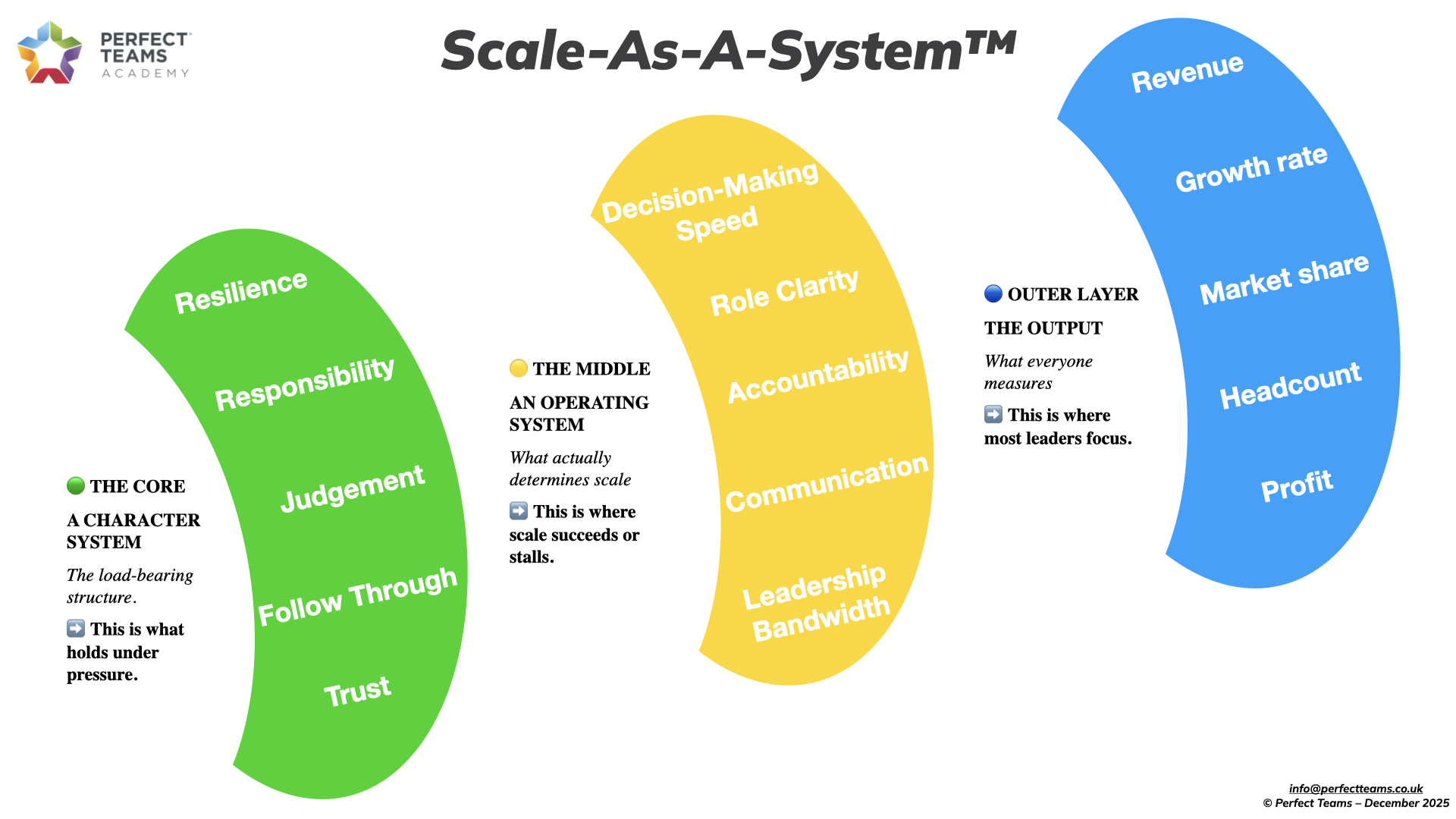
Scale-As-A-System™ reverses the perspective.
Strengthen the core.
Build the operating system.
Then make the system capable of producing the output.
Because:
You cannot scale output unless the system producing it can scale too.
Why Personality Isn’t Enough at Scale
Personality can tell us useful things about behaviour and preferences.
But understanding personality isn’t enough to tell us whether an organisation can carry the pressure of growth.
For that, we need to look deeper.
At character.
Responsibility.
Judgement.
Resilience.
Trust.
Follow-through.
And ultimately at capability.
Pressure has an interesting habit.
It reveals things.
The person who appeared decisive may become hesitant.
The collaborative team may retreat into silos.
The founder who believed they had delegated discovers that every significant decision still comes back to them.
The organisation discovers what it can actually do — rather than what everybody thought it could do.
That’s why character matters.
And why:
Character is the foundation. Capability is what we build from it.
What Perfect Teams® Really Does
Perfect Teams® isn’t simply a test.
It isn’t simply coaching.
And it isn’t simply training.
It’s a way of making the invisible visible.
Where does friction live?
Where do decisions stall?
Where does accountability break?
Where is capability concentrated?
Where are people dependent on one individual?
And:
What’s missing for the next stage of growth?
Once leaders can see the human system, they can start designing it deliberately.
Character becomes visible.
Responsibility can be distributed.
Teams become more complementary.
People become less dependent on the founder.
Individual capability becomes collective capability.
And the organisation becomes increasingly capable of carrying more.
That’s how you:
Add a zero without adding chaos.
The Truth Most Founders Discover Too Late
Growth doesn’t reward hope.
It rewards structure.
When the tide goes out, you don’t get to hide.
You discover whether the organisation you’ve built is genuinely capable of becoming something bigger.
Growth reveals the dependencies.
The bottlenecks.
The missing capability.
The weak relationships.
The decisions nobody owns.
The processes that only work because one particular person knows how to make them work.
That’s why:
Growth exposes everything.
And once you can see what’s really there, you can do something about it.
SUMMARY
Scale-As-A-System™ is the discipline of designing your organisation so growth strengthens it rather than breaking it.
There are hundreds of ways to improve efficiency and productivity.
But scale demands something more fundamental.
The system itself has to become more capable.
That means developing the people.
Strengthening leadership.
Distributing responsibility.
Improving communication.
Removing dependencies.
Building complementary teams.
And creating an organisation capable of carrying the next stage of growth.
Because the question isn’t:
Can we get bigger?
It’s:
Can what we’ve built carry the weight?
Growth exposes everything.
You can’t scale dependency.
You can’t download capability.™
Build the capability before you need it
Perfect Teams® helps leaders see the human system inside their organisation — where capability exists, where dependency remains, and what’s missing for the next stage of growth.
Originally published 15 January 2026. Updated August 2026.
 Article by: