

Work & The Capability Crisis™
BUSINESS OWNERS ARE TEARING THEIR HAIR OUT.
Not because young people are unintelligent.
Quite the opposite.
The complaint isn’t intelligence.
The complaint is capability.
And the gap between the two is showing up earlier than ever before.
Many are bright. Educated. Technically capable. Digitally fluent.
Yet employers keep telling me the same thing.
“They won’t pick up the phone.”
“They struggle to look people in the eye.”
“They don’t ask questions.”
“They avoid difficult conversations.”
“They wait to be told.”
Recently, a senior HR Director put it this way:
“As employers, we’re looking for people who can take initiative, accept responsibility, share ideas, ask questions, and handle setbacks, criticism, and competition.”
That struck me.
Because she wasn’t describing qualifications.
She was describing capability.
And that, I believe, is one of the clearest manifestations of what I call The Capability Crisis™.
Not a crisis of intelligence.
A crisis of readiness.
Work Has Changed
Modern working life is more demanding than ever.
Faster. More interactive. Less predictable.
Technology has accelerated everything.
Competition is global. Feedback is instant. Expectations are higher.
The modern workplace rewards people who can communicate clearly, think independently, adapt quickly, build relationships, recover from setbacks and take responsibility.
The context is modern. The capabilities are timeless.
And that’s where the problem begins.
Because many people have been educated for a world that no longer exists.
They have been taught what to think. Less often, how to show up.
I’d Never Been Shown How
People often ask how I got into this work.
My answer is always the same.
I failed.
Many years ago, while working in California, I was responsible for a major hospital project.
I’d built strong relationships. I’d done the technical work. I’d positioned us perfectly.
All I had to do was present our proposal.
It should have been straightforward.
Instead, I walked into a room full of people I wasn’t expecting.
My confidence evaporated.
My knees shook. My palms sweated. I stumbled my way through the presentation.
We lost the contract.
The cost to me personally at the time was $50,000 in lost commission.
On the very frosty drive back, Steve, my boss, gave me a simple piece of advice:
“Neil, you need to learn how to speak in public.”
So I did.
I invested in myself.
I learned.
I practised.
A few months later, I found myself standing in front of 350 people giving a keynote presentation.
This time it was completely different.
I had the audience in the palm of my hand.
Afterwards, Steve came running up, poked me in the shoulder and said:
“Why didn’t you do that at Huntington Hospital?”
Without thinking, I replied:
“Steve, it wasn’t that I couldn’t. I’d never been shown how.”
The moment the words left my mouth, I realised something important.
It wasn’t that I lacked intelligence.
It wasn’t that I lacked potential.
I simply lacked a capability I had never been shown or taught.
And I suspect millions of people find themselves in exactly the same position today.
The Great Confusion
We have become remarkably good at measuring what people know.
Exams.
Certificates.
Degrees.
Accreditations.
Qualifications.
Yet employers do not hire qualifications.
They hire capability.
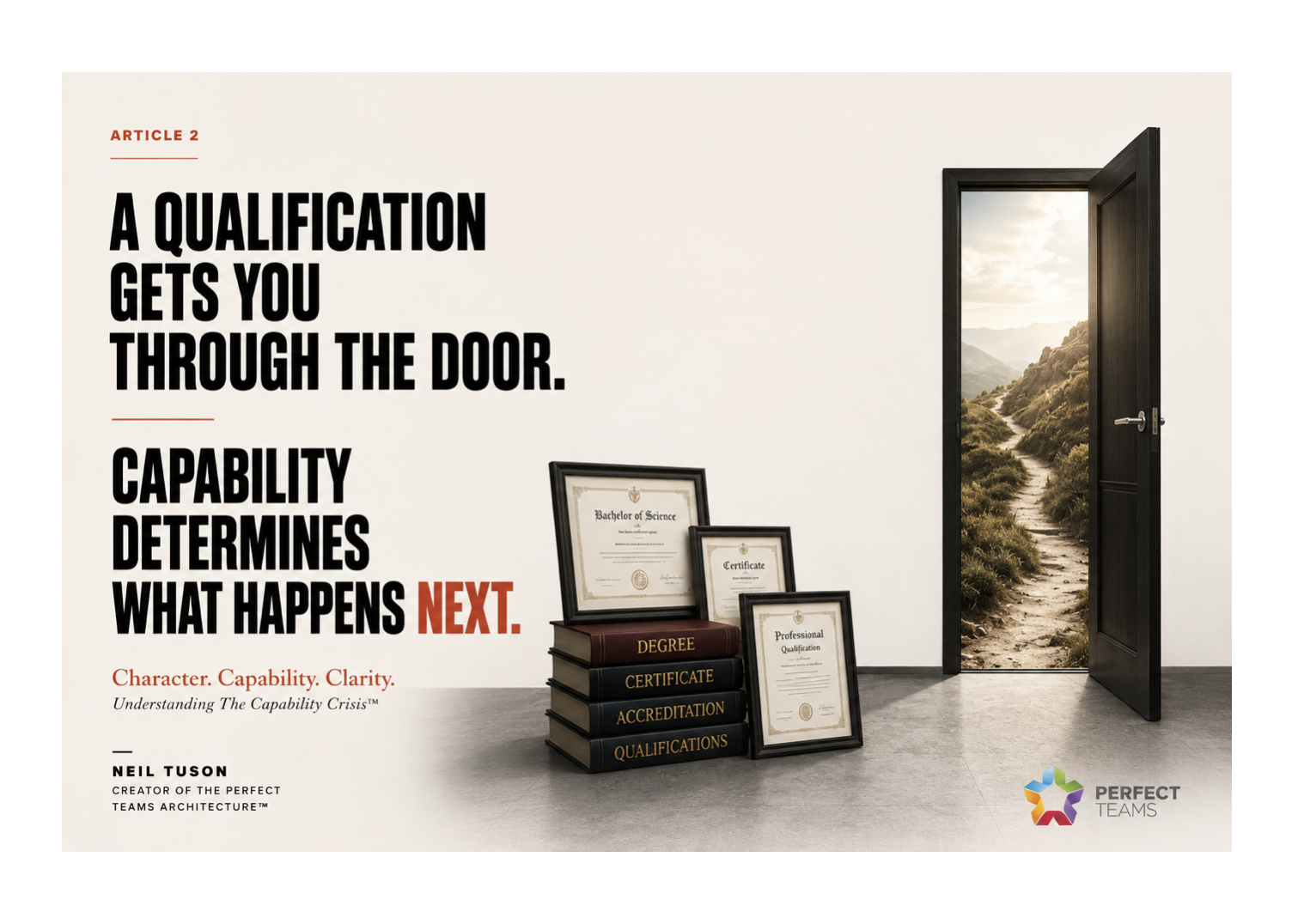
A qualification may get you through the door.
Capability determines what happens next.
Can you communicate?
Can you build trust?
Can you ask questions?
Can you recover from criticism?
Can you take responsibility?
Can you keep going when certainty disappears?
That is why so many intelligent people become stuck.
Not because they lack knowledge, but because modern life rewards capabilities that few people are deliberately taught.
The Workplace Has Moved
Most of us were raised in systems designed around dependency.
School tells us where to sit, what to study, when to speak and what success looks like.
Work increasingly asks:
What do you think?
What do you recommend?
What are you going to do about it?
Employers want initiative, ownership, judgement and responsibility.
They want people who can solve problems without waiting to be told what to do.
In other words:
Modern work increasingly rewards independence.
And this is where the tension begins.
Because many people arrive at work highly qualified, yet still waiting for someone else to provide the answers.
The Real Challenge
That conversation with the senior HR Director was one of the most revealing conversations I’ve had this year.
She wasn’t asking for better qualifications.
Or higher grades.
Or more certificates.
She was looking for people who could think for themselves.
People who could contribute.
People who could recover from setbacks.
People who could accept responsibility.
People who could cope.
That is a very different conversation.
And perhaps that is why so many employers are feeling frustrated.
They are not struggling to find intelligent people.
They are struggling to find prepared people.
Young professionals face enormous challenges: high expectations, fierce competition, rapid change, economic uncertainty and relentless pressure to succeed.
The challenge isn’t simply getting a job.
It’s building a career, adapting, thriving, maintaining well-being and continuing to grow.
But there is good news.
Capability can be developed.
Confidence can be developed.
Communication can be developed.
Resilience can be developed.
Leadership can be developed.
These are not fixed traits. They are capabilities that can be built.
Conclusion
The Capability Crisis™ is not a shortage of intelligence.
Nor is it a shortage of potential.
It is the growing gap between what modern life demands and what people have been shown how to develop.
Work is simply where that gap becomes visible first.
Which brings me back to Huntington Hospital.
The most important lesson I learned wasn’t about public speaking.
It was this:
It wasn’t that I couldn’t. I’d never been shown how.
I suspect millions of people are still waiting to be shown how.
The Capability Crisis™
Neil Tuson is exploring why many careers stall not because of intelligence, but because people are rarely taught the human capabilities on which progression depends.
Character. Capability. Clarity.
Originally published 18 June 2026. Updated August 2026.
 Article by: